This blog was written by Dr Louise Wetheridge, Education Evaluation Lead (2022-2026) at DELVe, a consortium of research and evaluation partners led by Ecorys UK.
In an increasingly unstable and unpredictable operating environment, the findings and lessons from a recent evaluation of the FCDO-funded flagship education programme in Nigeria – PLANE (Partnership for Learning for All in Nigeria) – offer positive and valuable insights about transforming children’s experience of primary schooling.
Nigeria’s education system faces profound structural challenges. Nearly 80 million young Nigerians are unemployed – a crisis rooted in part in weak foundational learning in the primary years. In northern states, learning poverty runs deepest. Climate change and food insecurity are compounding existing challenges to education. The withdrawal of USAID from basic education in Nigeria has removed a significant source of funding and technical support, placing greater pressure on programmes like PLANE to demonstrate what works and to sustain gains within government systems as well as increasing government responsibility for the continual delivery of quality basic education.
PLANE (2019-2027) works with the Government of Nigeria at federal level and in five states – Kano, Kaduna, Jigawa, Borno and Yobe – to improve foundational teaching, school quality and education management, with a focus on marginalised groups including girls and children with disabilities.
In 2025, the Human Development Evaluation Learning and Verification Service (DELVe) led a midline evaluation of PLANE at a pivotal moment for the programme and its operating context. The evaluation aimed to understand the contributions to change in primary education being made and sustained by PLANE, and the opportunities to strengthen this work in the future. The team visited 53 primary schools, meeting students, caregivers, school staff, local, state and federal education officials, CSOs and implementing partners. Our results reveal three areas of significant progress:
Structured mother-tongue pedagogy packages work
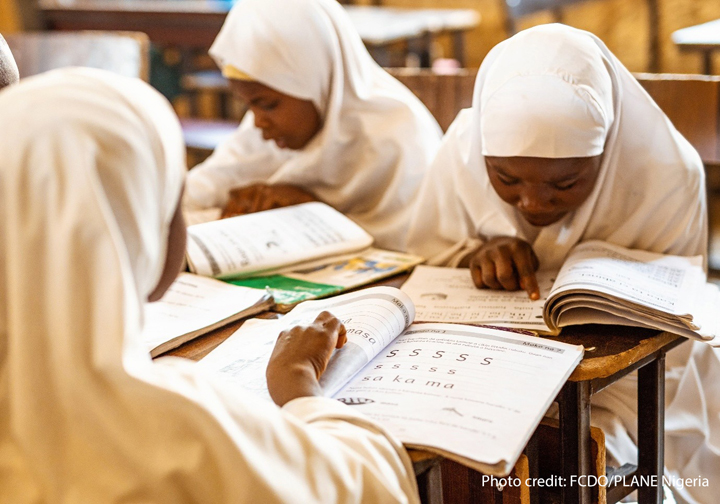
In all states, partners introduced mother-tongue structured pedagogy packages in schools. In Borno and Yobe, the packages are based around the use of Kanuri or Hausa to teach maths and literacy with teacher training and guides for over 7,000 teachers. In 2024-2025, the proportion of ‘beginner’ level students fell by an average of 48% in literacy and 37% in maths. The Kanuri-specific programme increased the proportion of fully proficient ‘numerate’ learners by 32% that year.
“The PLANE project has made visible improvements. We’ve seen children move from being unable to write their names to composing full sentences.” (Borno State Education Official)
In Kano, Kaduna and Jigawa, a Foundational Skills package designed and distributed to PLANE schools has included teacher guides, visual aids, materials and play-based activities in Hausa with in-service training for 12,000 maths and literacy teachers. Student learning outcomes in maths and Hausa have improved markedly: by July 2025, 56% of P4 students had attained basic literacy and 84% reached basic numeracy – beyond the programme’s 50% target. Classroom observations indicated that up to 45% more students show understanding, critical thinking and time-on-task in lessons in 2025 compared to 2022.
Child protection structures improve learning
A combination of three elements – training for state government education officials, head teachers, teachers and school-based management committee members; ongoing support through School Support Officers; and standards and structures such as those provided by child protection committees – have improved schools’ and communities’ awareness, attitudes, practices and responses towards child protection. Schools are more nurturing, inclusive environments with increased student attendance, especially among girls.
“Our safeguarding plan clearly defines pathways to report and resolve any form of abuse. It creates a safe and secure learning environment for children at school.” (Teacher, Jigawa state)
Putting the federal government’s Minimum Standards for Safe Schools into practice in Borno and Yobe has provided a strong basis for localised change. Multi-level approaches to addressing child protection are imperative, combining policy guidance with localised structures and standards, intensive training and routine support.
Technical support to policy development sustains gains
Federal and state education policy and governance reforms have been bolstered by PLANE’s contributions in teacher recruitment, deployment and retention; safe schools; and girls’ education. Quality assurance and accountability mechanisms have helped to track the institutionalisation, implementation and effects of reforms and address needs at local levels. Government officials credited PLANE’s technical support for improving the quality of policy drafts and building consensus. This support has strengthened the sustainability of programme gains and education sector transformation.
Three takeaways from PLANE’s midline evaluation
The effectiveness of structured pedagogy packages depends on materials production, distribution, tracking and training delivery at scale that are built into education budgets and plans. Reaching beyond core subject teachers through local support staff like School Support Officers – helps spread effective teaching across the whole school. PLANE packages are now being upscaled via state governments and the World Bank’s new HOPE-EDUCATION investment.
Mother-tongue based teaching and learning has contributed to PLANE’s success in raising foundational literacy and numeracy, especially in early grades. PLANE’s evaluation suggests that building mother-tongue led models for teaching and learning into the education system with code-switching and expanded evidence-based approaches to language of instruction is likely to raise learning outcomes for all children.
New and revised basic education policies merit continuous monitoring and technical support to ensure they are maintained, resourced and delivered effectively and sustainably. Reforms are accelerated and sustained when they are based on committed, efficient partnerships with state and non-state partners. PLANE’s Lessons from Practice on education policy reform is a valuable guide to policy development and realisation at school level based on collaboration and government ownership.
The evaluation continues to inform scale-up and sustainability of PLANE’s innovations. Read the PLANE Midline Evaluation Report here.