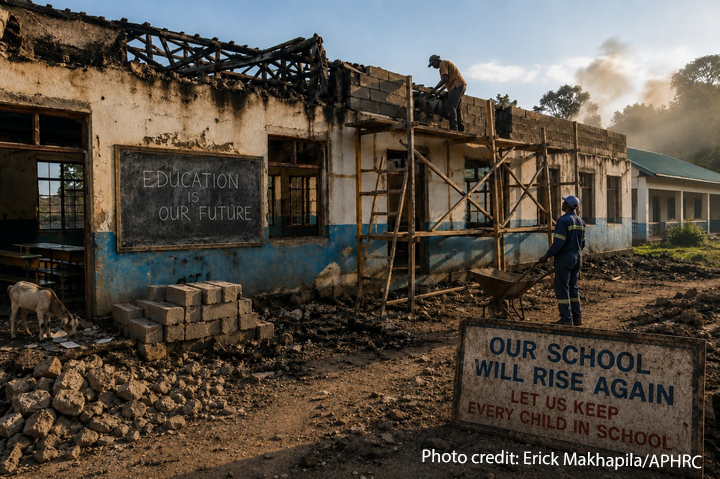
This commentary was written by Erick Makhapila, Researcher, African Population and Health Research Center, Nairobi, Kenya.
Each time a boarding school in Kenya sends students home after a fire or unrest, the same scene plays out on reopening. For most families, that should be the end of the story: their children were not involved and are simply going back to learn. Instead, many arrive at the gate to find a second instruction waiting: pay toward repairing or rebuilding what was damaged, regardless of how many students, if any, are found responsible.
The smoke barely clears before the invoices arrive. Welcome back. Please see the cashier first. There are always two disasters. The first is visible: death, injury, trauma, property destroyed. The second arrives quietly, in a letter demanding payment from every family before their child can return to class, regardless of what they were doing when it happened. Kenya’s secondary schools have been living through both disasters since late May 2026.
Utumishi, Gilgil: 16 dead and questions about a locked door
On the night of 27–28 May 2026, the Meline Waithera Dormitory at Utumishi Girls school caught fire, killing 16 students and injuring 79 others. Nine students were later remanded to a children’s home for 21 days as detectives investigated suspected arson. One emergency exit was reportedly not opened in time, forcing students through a single doorway, and security guards failed to break it open. Early reports raised questions about staff supervision, though accounts differ and no findings have been formally established.
Kenya’s history of deadly school fires stretches back to Kyanguli in 2001 (67 dead), Moi Girls Nairobi in 2017 (10 dead), and Hillside Endarasha in 2024 (21 dead). Locked exits, overcrowded dormitories and absent supervision have recurred in every inquiry – and recurred at Utumishi.
Ambira Boys, Siaya: Ksh 33,000 per child – or stay home
Nine days before the Utumishi fire, students at Ambira Boys High School in Siaya rampaged at night over a Ksh 33,000 penalty, vandalising dormitories and offices. Court documents say the unrest was carried out by Form 4 students with grievances against the administration. The school was closed indefinitely.
Ambira is not a fire case, but the aftermath followed the same logic. Citing Ksh 50 million in damage, the Board imposed a Ksh 33,000 levy on every learner, including Grade 10 students earlier assured they would not be penalised. On June 5, 2026, 165 parents of Grade 10 students filed a constitutional petition in Nairobi, led by Victor Otieno, asking the court to declare the levy unlawful and order immediate readmission.
The pattern: different incidents, identical response
Ambira and Utumishi differ in cause – one a strike, one a fire – but share an identical response: bill every family, deny readmission until payment is made. A wave of school closures across Kenya in early June 2026 shows how widespread this has become, with damage levies following in its wake. In September 2025, eight students at Litein Boys High School were arrested after torching classrooms; families faced the same post-incident levy. Collective billing of students who had no part in the unrest raises important questions about compliance with the Basic Education Act.
What the law already says
Kenya’s Basic Education Act No. 14 of 2013 limits the additional charges schools may impose and protects learners from exclusion for non-payment. The Ambira petition is, in effect, a test of whether these protections can be enforced without families having to litigate their way back through the school gate.
Boards face real constraints: weak funding, delayed capitation, slow insurance. But they do not answer the legal questions raised by billing and barring uninvolved students until payment is made. The cost of institutional failure should not fall on the households least able to carry it. There is a quieter third disaster, too: learning lost compounds the interruption that started it, and girls face a higher risk of never returning. The children who survived – at Endarasha, at Utumishi, at every school sent home this term – carry trauma no levy covers, no fee statement reflects, and no one is asked to foot.
Three things that need to change
None of this requires new legislation – only enforcing what exists, and closing the funding gaps that make families the default insurers of public education.
- First: Establish a dedicated emergency school restoration fund, so boards have an alternative to billing families after a disaster. County education bursaries, National Government-Constituency Development Fund allocations, or a ring-fenced share of school insurance levies could help seed it.
- Second: Guarantee unconditional readmission while any levy dispute is resolved. A court petition should not be the only route open to parents who cannot afford the re-admission fee.
- Third: Make psychosocial support a funded, mandatory part of any disaster response. Trauma does not appear in repair budgets – the mental health needs of affected students should appear in policy.
What remains is the decision to act
None of this is hypothetical. It plays out at school gates every time one reopens after a fire or unrest, bills already waiting. The Ambira petition remains before the Milimani Constitutional and Human Rights Division, its legality undetermined; the Utumishi investigation continues, with minor suspects and no charges filed. What is already clear is the pattern that has followed every incident so far: families are billed. Twenty-eight years after the Bombolulu Commission’s recommendations on dormitory fire safety, students at Utumishi died at a locked door.
The pressure has not gone unnoticed at the highest levels: in June 2026, the state transferred the Basic Education Principal Secretary to the Tourism docket – a move some commentators viewed as reflecting concern over the rising number of school fires and incidents of unrest. But structural accountability cannot rest on personnel changes alone.
The fires take lives. The recovery process should not take futures of our children.