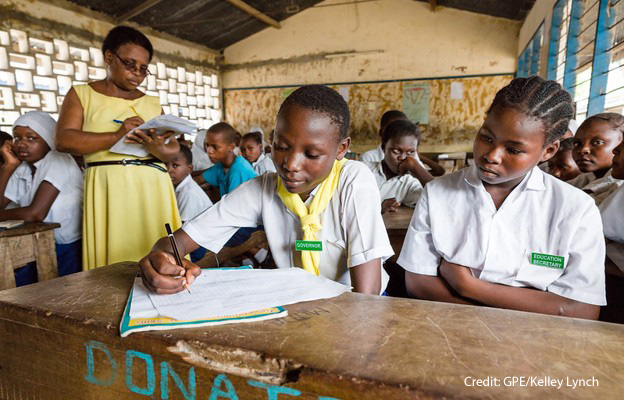
This blog is written by Abdimalik Ibrahim Farah, Research Officer at the African Population and Health Research Center (APHRC), Nairobi, and a PhD candidate at Kenyatta University.
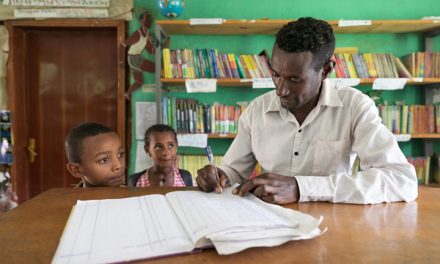
Imagine sending a teacher through months of professional training in play-based, learner-centred instruction – and then placing her in a classroom with no walls, no textbooks and no visual materials of any kind. This is not hypothetical. It is the reality for a majority of teachers in APHRC’s new study of foundational literacy and numeracy across the Dadaab Refugee Complex in Garissa County and Kakuma/Kalobeyei Settlement in Turkana County, Kenya.
Between February and March 2026, we assessed 301 Grade 2 and 3 learners and observed and surveyed 25 teachers across 27 schools. 56% of observed lessons took place outdoors. 80% of classrooms had no textbooks at all. Only 32% had any visual display – an alphabet chart, a number line, anything a child could look at to anchor new learning. Some schools had gone four consecutive years without a single textbook delivery.
The consequence shows up directly in the data. Availability of basic writing materials was the single strongest contextual predictor of learners’ reading outcomes, significantly predicting both word reading and oral fluency. But the more striking finding is what statisticians call a moderation effect: classrooms with visual learning materials significantly amplified the positive effect of play-based instruction on word reading. Put simply, play-based, interactive teaching only translates into literacy gains when a minimum of physical infrastructure and materials is in place. Strip that away and the same pedagogy that works elsewhere can flatten or even reverse.
This reframes a debate that too often collapses into ‘which pedagogy is best’. Our findings suggest a different question: which pedagogy is possible, given what a classroom actually has? Teachers are not failing to deliver good instruction because they do not know how. Many have been through TeachWell or TCCD training, which teachers, headteachers and education officials across both counties consistently named as the most significant source of pedagogical change in their careers, with communities of practice singled out as the most effective ongoing support. But training cannot manufacture a roof or a stock of exercise books, and funding cuts during our study period – including the withdrawal of American donor support – made this worse in real time, with some schools losing the majority of their trained teaching staff within a single term.
There is a second, quieter finding worth surfacing here. Neither academic qualification nor years of experience predicted overall pedagogical practice quality in our models. But teaching qualification – specifically, whether a teacher had actual pedagogical training, as distinct from general academic credentials – did significantly predict learners’ word reading and oral fluency scores. In some of the schools we visited, over 90% of teachers are untrained incentive workers on stipends, excluded from Teachers Service Commission (TSC) registration and the professional pathways that come with it. The current flat-rate incentive pay structure does not distinguish between a trained and an untrained teacher, which means there is no structural incentive built into the system for a refugee teacher to pursue the qualification that we now have direct evidence improves learner outcomes.
Taken together, this points toward a set of concrete, fundable priorities rather than a diffuse call for ‘more resources’. Basic visual materials – alphabet charts, number lines, illustrated displays – should be treated as a minimum classroom standard for Grades 1–3, not an optional extra, given the direct evidence that they are a pre-condition for interactive teaching to work at all. Semi-permanent classroom structures for early grades deserve to be framed as an educational investment, not merely an infrastructural one, given their direct relationship to reading and numeracy outcomes. And a pathway toward TSC recognition for refugee teachers holding genuine teaching qualifications would, for the first time, align the incentive structure with what the evidence shows actually helps children learn to read.
The uncomfortable truth in this data is that we already know enough to worry less about whether teachers in Dadaab and Kakuma know what good instruction looks like, and more about whether the system around them will ever let them deliver it. Professional development has done real work here. It cannot do the rest of the job alone.
This blog draws on APHRC’s 2026 study, ‘Teachers’ Pedagogical Practices and Their Influence on Foundational Literacy and Numeracy Skills among Early Grade Learners in Refugee Camps in Kenya’, conducted in the Dadaab Refugee Complex (Garissa County) and Kakuma Refugee Camp/Kalobeyei Settlement (Turkana County).