This blog is written by Abdimalik Ibrahim Farah, Research Officer at the African Population and Health Research Center (APHRC), Nairobi, and a PhD candidate at Kenyatta University.
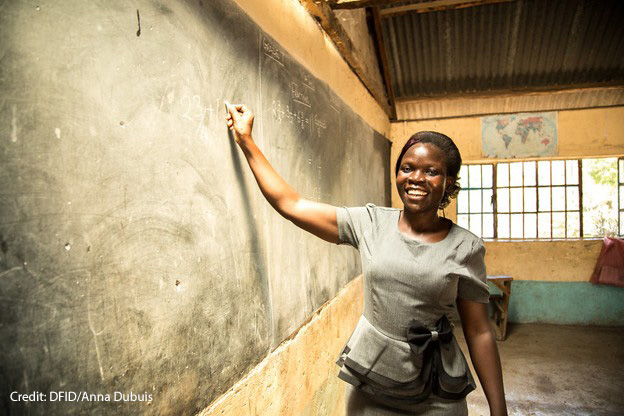
In a Grade 3 classroom in Kakuma, a teacher pauses mid-lesson. She asks learners to show thumbs up or thumbs down – do you understand, or not? Some hands go up slowly, uncertainly. She notices, and she changes course before moving on. It costs nothing. It takes seconds. And according to new research from the African Population and Health Research Center (APHRC), it may be doing more for children’s foundational literacy and numeracy than almost anything else happening in these classrooms.
Between February and March 2026, our team visited 27 schools across the Dadaab Refugee Complex in Garissa and the Kakuma/Kalobeyei settlement in Turkana, observing 25 teachers, surveying them on their classroom practices, and assessing 301 Grade 2 and 3 learners using EGRA and EGMA tools. We wanted to understand a question that has surprisingly little empirical evidence behind it in refugee education: which specific pedagogical practices actually move the needle on foundational literacy and numeracy, and which don’t?
The headline finding is sobering on its own. Close to 40% of assessed learners scored zero on letter sounds. Nearly 45% scored zero on non-word reading. More than a third could not read a single word aloud with fluency. After two or three years of schooling, a large share of children in these camps are not yet reading.
But the more interesting finding is about why, and what might change it.
We examined three practices that Kenya’s Competency-Based Curriculum treats as foundational for early grades: play-based and interactive instruction, formative assessment and inclusive teaching. Inclusive teaching – largely warmth, encouragement and emotional support – was the most consistently used. Play-based instruction came second. Formative assessment – the simple, ongoing practice of checking whether learners are actually understanding, and adjusting accordingly – was the least used of the three. Nearly half of surveyed teachers said they never used a structured comprehension check in the reference week. In classroom observations, 44% of teachers asked zero higher-order questions across an entire lesson.
And yet, formative assessment was the only practice that showed a consistent, positive relationship with learner outcomes across our statistical models. It significantly predicted letter-sound knowledge overall. In Turkana specifically, it predicted gains in word reading, missing-number identification and subtraction. Meanwhile, play-based instruction – the practice most associated in policy conversations with ‘good’ competency-based curriculum teaching – showed a negative association with letter sounds and word reading in the pooled sample. That is not an argument against play-based learning. It is very likely a story about implementation: play-based methods in overcrowded, outdoor classrooms with no materials often collapse into unstructured activity rather than structured, purposeful learning. The practice isn’t the problem. The conditions it is asked to operate in are.
What makes formative assessment different is that it does not require a roof, a textbook or a trained specialist. It requires a teacher who pauses, asks and listens – the thumbs up, the quick oral check, the ‘who can explain this back to me’. One teacher we interviewed described watching for ‘blank faces’ as her signal to change approach mid-lesson. Another talked about how learners working in pairs gave her real-time feedback she could act on immediately. These are not expensive interventions. They are habits of attention.
This has a direct implication for how professional development is designed and resourced in crisis-affected education settings. Programmes like TeachWell and Teacher Continuous Capacity Development (TCCD) – which teachers across both counties consistently named as their most valuable source of pedagogical change – should treat formative assessment not as one module among several, but as the highest-leverage single skill worth reinforcing through coaching, communities of practice and classroom observation cycles. It is, in a resource-starved system, close to a free intervention with a demonstrable return.
None of this means formative assessment is a silver bullet. Our data are equally clear that it cannot substitute for walls, textbooks or trained teachers where those are absent entirely – more on that in a companion piece. But in a field where every intervention seems to compete for scarce funding, it is worth being honest about which practices are underused – not because they are hard or costly, but because they have been under-emphasised. Formative assessment is one of them. Fixing that starts not with a budget line, but with what gets modelled and observed in teacher training.
This blog draws on APHRC’s 2026 study, ‘Teachers’ Pedagogical Practices and Their Influence on Foundational Literacy and Numeracy Skills among Early Grade Learners in Refugee Camps in Kenya’, conducted in the Dadaab Refugee Complex (Garissa County) and Kakuma Refugee Camp/Kalobeyei Settlement (Turkana County).