
This blog was written by Dr Mohammad Naeim Maleki, Research Associate, School of Education and Lifelong Learning, University of East Anglia. For the 2025 UKFIET conference, a record 37 individuals from 15 countries, including Naeim, were provided with bursaries to assist them to participate and present at the conference. The researchers were asked to write a short piece about their research or experience of attending the conference.
Adult literacy has long been seen as an important route to improving people’s lives. Governments and development organisations invest significant resources in literacy programmes with the hope that adults will gain the knowledge and skills needed to improve their livelihoods, support their families and participate more fully in their communities. Yet many programmes continue to struggle to make learning relevant to learners’ everyday lives. One reason may be that they begin by focusing on what learners cannot do, instead of recognising what they already do through literacy and numeracy in their daily lives.
This challenge is particularly evident in Afghanistan. After decades of conflict, political instability and unequal access to education, millions of adults have had little opportunity to attend school. Adult literacy programmes have therefore focused largely on teaching reading, writing and numeracy as classroom skills. However, my experience in the field suggested a different question: What if literacy programmes started with the literacy practices that adults already use every day?
This blog builds on a presentation I gave at the UKFIET Conference 2025 and draws on findings from my PhD ethnographic study of adult male literacy learners in Afghanistan. Instead of asking what learners lacked, I explored how they used literacy and numeracy across different literacy domains and what these everyday practices might offer adult literacy programmes.
Everyday literacy across different literacy domains
My study was informed by Street’s (1984) ideological model of literacy, which views literacy as a social practice rather than simply a technical skill. Instead of treating literacy as something that exists only in classrooms, this perspective encourages us to look at how people use literacy in different parts of their everyday lives. This perspective also connects with Alan Rogers’s (1999) ‘real literacies’ approach, which argues that adult literacy teaching should build on the literacy practices and tasks that people already encounter in their everyday lives.
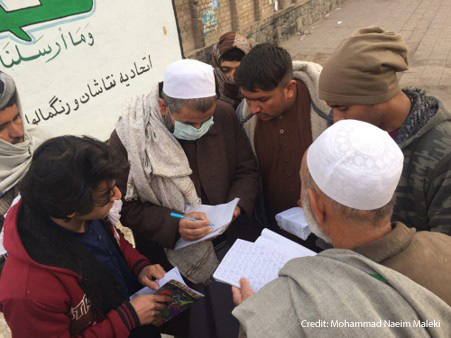
Over the course of a year, I observed adult learners in four literacy domains: the workplace, home, in their place of worship and classroom. I spent time with them at work, visited their homes, observed literacy classes and had many formal and informal conversations. Rather than finding adults with few literacy practices, I found people who were already using literacy and numeracy in ways that mattered to them, even though these practices were rarely recognised within formal literacy programmes.
One participant, Zabi, worked as a carpenter in a sofa workshop. During one visit, he and his apprentice were trying to calculate the dimensions of a piece of timber. They counted on their fingers, checked ruler markings and talked through the calculation before agreeing on the answer. This was not a school mathematics lesson. It was numeracy embedded in everyday work. The calculation mattered because getting it wrong meant wasting materials and time.
Zabi’s story was not unusual. Other participants used a smartpen to learn Qur’anic Arabic at home before attending literacy classes. Some regularly helped their children or younger siblings with homework. Others used mobile phones to communicate with customers or exchanged religious texts with friends. These examples looked very different from what is usually taught in literacy classrooms, yet they were all meaningful literacy practices that learners valued and used every day.
Mobilising local knowledge into literacy programmes
These experiences raise an important question. If adults already practise literacy in their everyday lives, why do literacy programmes so rarely make use of these practices?
Recognising learners’ existing literacy practices does not mean replacing formal curricula with everyday activities. Instead, it means using those activities as starting points for learning. A carpenter’s measurements can introduce mathematical concepts. Reading the Qur’an can support language learning. Helping children with homework can become the basis for reading and writing activities in class. Rather than asking learners to leave their experiences at the classroom door, programmes can build on what they already know.
This also means creating stronger links between different literacy domains. Learning does not happen only in classrooms. People move constantly between work, home, religion and education, carrying knowledge from one domain into another. Literacy programmes can become more relevant by recognising these connections instead of treating classroom learning as separate from everyday life.
The same principle applies to assessment. Instead of measuring progress only through reading and writing exercises, programmes could also consider how learners use literacy and numeracy in their daily lives. This shifts attention away from literacy as a collection of isolated skills and towards literacy as something people actively practise within their families, workplaces and communities.
Looking ahead
As governments and development organisations continue to invest in adult literacy as part of Sustainable Development Goal 4, there is an opportunity to rethink where literacy programmes begin. Adult learners do not arrive in classrooms as blank slates. They bring with them knowledge, experiences and literacy practices that have developed through work, family life, religion and community participation.
This is one of the most important lessons from my research. Rather than beginning with the question, “What do learners lack?”, perhaps we should begin by asking, “What are learners already doing with literacy, and how can we build on it?” Starting from learners’ own literacy practices will not solve every challenge facing adult literacy programmes, but it is an important step towards making them more relevant, more responsive and more closely connected to the realities of people’s lives.