This blog was written by Professor Nidhi Singal and Dr Thilanka Wijesinghe, Cambridge Network for Disability and Education Research and Faculty of Education, University of Cambridge. The team in India is led by Dr Jwalin Patel, and supported by Muskan Khanna, and Magdhi Diksha, based at the THRIVE Research Centre, TIDE Foundation, India.
What does it mean to be a teacher with disabilities in India’s mainstream schools? This question guided a recently-completed pan-India study. Our goal was simple, but urgent: to listen to and amplify the voices of teachers with disabilities, whose realities remain largely invisible in education debates and policy.
Anusha’s story: Strength through adversity
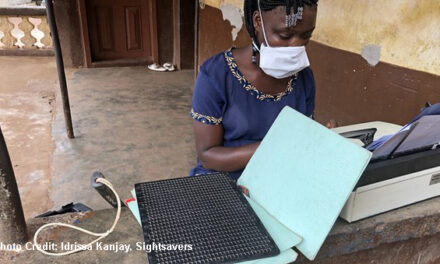
Anusha, an educator with visual impairment, with nearly two years of experience of working in a government secondary school and now a university lecturer, provided a candid perspective on navigating systemic neglect while viewing her disabled identity as a source for unique insights.
She describes herself as “a visually impaired woman… especially disability first, because that’s the most visible, most dominant and most contributory factor of my own identity.” Far from a limitation, she believes her disability gives her a unique connection with students: “If I have this limitation, maybe some sort of similar experience is going on with a student of mine.”
Yet her journey has been marked by systemic neglect. She recalled being excluded from parent-teacher meetings, with her principal sending another colleague in her place, as they did not wish to upset parents. Recounting another incident, she talked about an older student in her class behaving inappropriately, yet no one acted upon her complaint, let alone acknowledged her experience. “I discussed it with the sexual harassment committee – but they seemed more interested in suppressing the matter. They told me, you shouldn’t take it further. If you do, there will be inspections from other offices, which will not be good for the school. They didn’t do anything. Eventually, I had to escalate the issue to the director, but even then, nothing happened.”
Despite these barriers, Anusha drew strength from her family, friends and, most powerfully, her students. Sharing how her presence has changed the way her students perceive persons with disabilities, she mentioned, “…earlier these students had the perception that if there is a person who can’t see, maybe he or she is good at singing; [they] must look dishevelled; or maybe need some sympathy… But now they say that after we have met you, and interacted with you in class, we have changed the way we think (about persons with disabilities].”
She believes things are changing, albeit slowly: “Things have been moving in a positive direction… but there is a lot more to be done.”
Anusha’s voice is one of 25 teachers working in mainstream schools, across 10 Indian states featured in our study. Together, their experiences reveal the urgent need to centre teachers with disabilities in conversations about inclusive education.
Why this research matters
Globally, the Sustainable Development Goals commit to “inclusive and equitable quality education for all.” Yet while learners with disabilities receive increasing attention, teachers with disabilities remain overlooked.
In India, this gap is stark. Government data shows that teachers with disabilities comprise only 2.62% of government school teachers and just over 2% in private schools (UDISE+ 2021-22). Policies and key education reports rarely mention them.
Three turning points in a teaching journey
Taking a life-course approach, we explored three critical phases:
Becoming a teacher – training
All participants recounted challenges of inaccessible infrastructure in teacher training institutes, a near-total absence of disability-focused content, and negative attitudes among various people, which dented their confidence. However, seven also shared how their lecturers and heads of training institutes supported them, and in most cases, participants drew a lot of support from their family and peers. They provided them inspiration and encouragement and helped complete important work tasks, such as checking and editing written work, taking notes and support with using technology.
Securing a job – recruitment
Rohan talked about ‘being given a chance’ by someone who believed in his abilities. However, getting a job was not easy for many (nine teachers), as people made assumptions about their abilities to fulfil the different tasks required as a teacher. This is best captured in the following recollections:
“I was asked to leave from two or three schools, because they felt that I can’t do the work. During an interview in one school, I was asked, if I have 70% disability how can I be in the school for five hours?” (Rohan)
“When I got a call for an interview, I went there and the coordinator said, “you are blind, so how will you work? There is a lot of visual work. There is file work, so how will you do it?” (Sadhna)
Satendra shared how he was uncomfortable with people who were overly sympathetic towards persons with disabilities. Recounting an instance, when he went for an interview the very first question he was asked was “how did you manage to come here? We do not have lifts into our building. How did you manage it?”
Being a teacher – daily practices
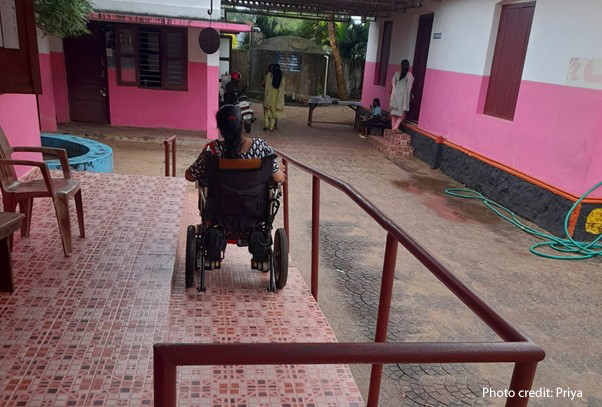
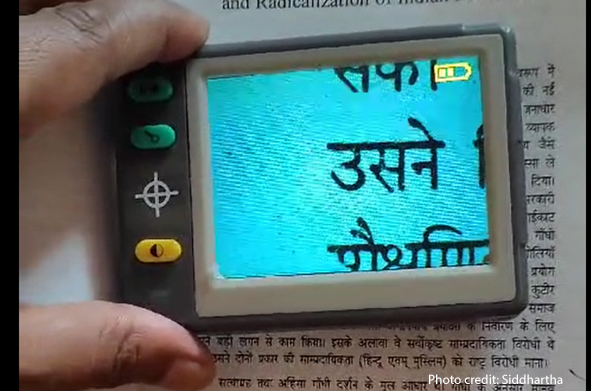
Ease of carrying out daily activities through accessible digital and physical infrastructure were highlighted by some of the participants. Amardeep talked about the school having provided screening reading software on his laptop, coloured the pathways for visibility, and installed railings along the walls, all of which “gives a lot of support… we can move independently in the school.”
On the other hand, significant physical barriers (such as inaccessible toilets), attitudinal hurdles (such as patronising colleagues) and structural neglect were commonly reported. As a female teacher summed it: I feel like “a minority in my own staff room.”
Teachers talked about balancing personal challenges and professional demands, often in inaccessible and unsupportive settings. Many described rethinking lesson plans, planning alternative assessments, and drawing on a range of classroom management practices to make learning inclusive, often drawing on personal resources. As Satendra pointed out, “I teach using my own laptop, because the facilities and the infrastructure are not available in my school. I use my own things.” In a similar vein, reflecting on the difficulty of marking written scripts, Anusha noted that she was always required to have her own assistant, at her own expense, to get things done.
And yet, across these accounts, there were powerful stories of resilience and dignity. Support from colleagues, respect from students and recognition as ‘just another teacher’ helped many teachers with disabilities persevere and thrive.
Purpose Beyond Barriers
Across these phases, our research found that teachers with disabilities navigate a complex interplay of barriers and enablers that shape both their professional identity and their motivation to teach. Their motivations remained deeply rooted in commitment to student growth.
“My goal as an educator is to enhance the knowledge of my students by being innovative in my teaching approaches… my focus is on teaching and nothing else.” (Vikram)
As Anusha powerfully expressed, “teaching is not only a career, but a way to empower myself and empower others”.
From voices to action: Teachers’ recommendations
Teachers’ narratives reveal not just barriers but opportunities for meaningful change. In moving from rhetoric to real inclusion, participants agreed, demands action in four key areas:
- Accessible infrastructure and resources
- Ensure school buildings, classrooms and facilities are fully accessible to teachers as well as students.
- Provide assistive technologies and teaching aids that enable professional growth.
- Policy, rights and advocacy
- Reframe disability in education policy from charity to rights, and include teachers with disabilities in India’s inclusive education agenda.
- Support networks of teachers with disabilities to foster collective advocacy and peer support.
- Inclusive teacher development
- Guarantee accessibility and adapted practicum experiences in teacher education.
- Embed disability inclusion across all teacher training programmes.
- Promote a holistic approach
- Expand research and data on teachers with disabilities to inform policy and practice.
- Treat inclusion as a shared responsibility of schools, communities and the wider education system.
Above all, the teachers we interviewed demonstrated remarkable resilience and agency. They are not merely surviving in mainstream classrooms; they are redefining what inclusion means for everyone. Their insights challenge us to see them not as passive recipients of support but as leaders in advancing equity across India’s schools. Their contributions need to be acknowledged and supported.