This blog was written by Sakina Jafri, doctoral student at the Faculty of Education, University of Cambridge. The blog focuses on the recent UKFIET event held on 4 February 2026, focusing on: Leaving No Learner Behind: Disability-Inclusive Education and the Post-2030 Agenda.
As 2030 approaches, attention is turning to what comes next for global disability-inclusive education. This blog explores how practices from diverse contexts can shape a post-2030 agenda that is more equitable, sustainable and accountable. Although disability-inclusive education sits at the heart of the Sustainable Development Agenda, its realisation is shaped by power, including who sets priorities, whose knowledge is legitimised and who is held accountable. The SDG deadline is therefore an opportunity to examine how power has operated within Education 2030 and how it must shift to move inclusion from rhetoric to structural change.
For learners with disabilities, exclusion is rarely accidental. It reflects how power operates through policy design, financing, data systems and school cultures that privilege normative assumptions about ability. Power shapes whose knowledge counts, often elevating technical expertise over lived experience and allowing external actors to drive reform. In this context, global commitments risk remaining rhetorical unless resources, authority and voice are redistributed. The question is no longer whether inclusion matters, but how power can be exercised differently. What would it take to move beyond a tick-box approach towards structural change? How can students and teachers with disabilities exercise real influence rather than symbolic participation in shaping educational reform?
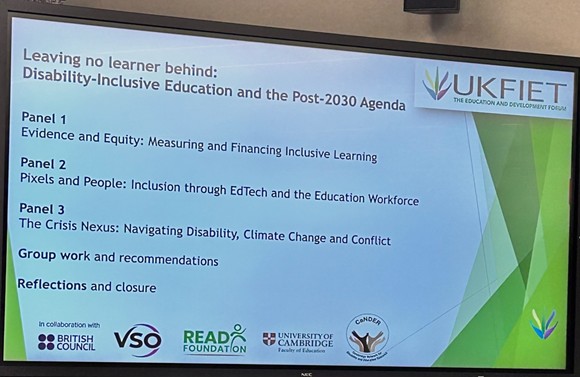
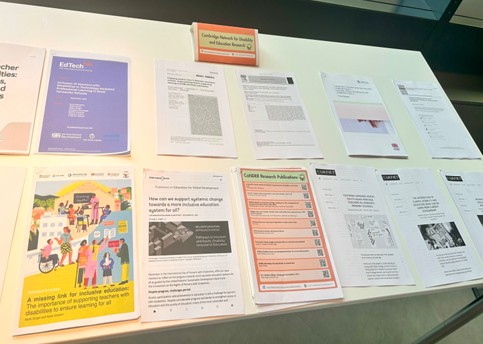
These tensions framed the recent event organised by UKFIET focusing on: Leaving No Learner Behind: Disability-Inclusive Education and the Post-2030 Agenda. All speaker slides from the day are available online. Across contexts, participants repeatedly raised questions of governance, accountability and whose expertise is legitimised in decision-making. Central was the role of power, who is excluded, and how it shapes every stage of reform. From agenda-setting and budgeting to implementation and evaluation, power determines which priorities advance, which voices are amplified and which experiences are sidelined. Sustaining disability-inclusive education therefore requires a more equitable distribution of authority and influence within education systems.
From margins to mainstream: Making inclusion structural
The overarching message of the day was clear: across South Asia, Sub-Saharan Africa, the Middle East, Latin America and Europe, education systems must be reimagined, so they serve all learners and all teachers, including teachers with disabilities. But reimagining systems is ultimately about confronting how power is organised within them. Inclusion is not achieved through minor classroom adjustments, symbolic gestures or checkbox use of technology. It requires systemic transformation, reshaping who makes decisions, how resources are allocated and whose experiences inform policy.
Disability cannot be viewed in isolation. It intersects with the brutal realities of poverty, gender inequity, conflict, displacement and climate vulnerability. Each of which are shaped by unequal distributions of power. Evidence shared during the event highlighted persistent injustices: persons with disabilities remain among the most excluded from labour markets globally, and are disproportionately affected by climate change and conflict. Broader systems of oppression and violence not only further marginalise persons with disabilities, but also generate disability itself (slides 89-99).
Education systems can have the potential to interrupt these cycles. However, this can only occur if inclusion is embedded within mainstream planning, financing and accountability frameworks, wherein power is exercised. Transforming outcomes therefore requires transforming governance structures, budgetary priorities and decision-making processes, so that that inclusion is not dependent on goodwill but secured through sustained political and institutional commitment.
Power, professionalism and who belongs in teaching
Teacher diversity emerged as a critical lever for change but also revealed how power operates within the profession itself. A diverse learner population requires a workforce that reflects abilities, identities and lived experiences. Who is permitted to enter, remain and progress within teaching is not neutral, it reflects institutional norms about competence, authority, and professionalism. Teachers with disabilities challenge deficit assumptions and expand notions of who belongs in professional spaces. Representation is not symbolic; it reshapes expectations, aspirations and distribution of professional authority.
Yet, discussions also highlighted how disability is structured within implicit hierarchies (slides 38-47). Physical disabilities are sometimes perceived as ‘easier’ to accommodate through infrastructure adjustments, while cognitive or psychosocial disabilities are framed as more ‘disruptive’. They reflect underlying power dynamics about whose needs are considered legitimate and whose are treated as burdensome. They influence hiring practices, promotion pathways, resource allocation and policy priorities. In doing so, they determine who is welcomed and who is excluded, both among students and within the teaching profession as well.
In my own research with teachers in London, disability was central to teachers’ narratives, shaping their professional identities and practices in profound ways. Teachers spoke candidly about navigating institutions that lacked understanding, flexibility or accommodation. Their experiences revealed how professional power is often conditioned on conforming to narrow norms of ability. As one teacher reflected, “There’s no consideration that a teacher could also have some learning or other special needs. It made me question teaching as a career for me…schools aren’t inclusive for us”. This testimony underscores a broader tension: systems that expect teachers to enact inclusion often fail to extend inclusion to teachers themselves. Without confronting the power structures embedded in recruitment, evaluation and workplace culture, diversity within the teaching workforce will remain aspirational.
Enhancing student visibility: Data, power and accountability
Student visibility or the lack of it emerged as another strong theme. In many contexts, children with disabilities remain invisible in national data systems. They are inconsistently identified in surveys, enrolment records or progression data. This invisibility is not neutral. Data systems reflect decisions about what and who counts. When disability is poorly captured or narrowly defined, it signals how power shapes recognition, priority-setting and ultimately resource allocation.
Without reliable data, policies cannot be effectively targeted, and resources cannot be allocated equitably. Evidence presented during the event showed that children with moderate to severe disabilities often experience overlapping challenges, which are strongly associated with lower enrolment and weaker foundational literacy and numeracy outcomes. When data systems fail to capture complexity, disadvantage deepens because systems lack the mechanisms to acknowledge and respond to them.
Data is not merely technical infrastructure; it is an instrument of power. It shapes whose experiences are visible, whose needs are legitimised and whose exclusion remains hidden. Strengthening identification and data collection is a political choice. To count children is to recognise their rights; to disaggregate is to confront inequity. To analyse patterns of exclusion is to accept responsibility for addressing them.
Participants returned to a central principle: systems that work for children with disabilities are stronger systems for all learners. Flexible pedagogies, early intervention and attention to wellbeing improve overall quality of education. Universal approaches to curriculum design reduce the need for reactive accommodations and redistribute responsibility for inclusion across the system rather than placing it on individual learners.
Beyond access: Rebalancing power in education systems
The SDGs placed inclusive education firmly on the global agenda. Yet agenda-setting is not the same as transformation. While inclusion has gained rhetorical prominence, the distribution of power within and across education systems continues to shape whose rights are realised in practice. Progress remains uneven. In many low-and-middle-income countries, children with disabilities are still less likely to enrol, attend consistently or achieve foundational skills. Teachers with disabilities remain significantly underrepresented, facing structural barriers to entry, progression and professional recognition.
These patterns are not incidental and reflect how institutional power governs recruitment standards, professional norms, budget allocations and policy priorities. Strengthening inclusive education therefore requires attention not only to learners, but also to who is recruited, supported and retained within the teaching workforce. Who is seen as a legitimate educator? Whose needs are accommodated within professional structures? Whose expertise is valued?
As conversations turn toward the post-2030 framework, access alone is not enough. The focus must shift to meaningful participation and voice. Inclusion is not secured by enrolment data alone; it is shaped by who has authority within classrooms and institutions. Identification alone is not enough. Data alone is not enough. Technology alone is not enough. These tools matter but without shifts in governance and accountability, they do not alter the underlying power relations. Inclusion requires sustained, system-wide reform:
- Pre-service and in-service teacher education that embeds inclusive pedagogy
- Investment in accessible infrastructure
- Community engagement to address stigma and reshape social norms
- Accountability systems that track enrolment, participation and progression.
Most importantly, inclusion requires political will, the willingness to prioritise disability within national budgets, policy frameworks and international cooperation. Without sustained commitment at both national and global levels, disability-inclusive education risks remaining rhetorically central yet practically peripheral. The post-2030 moment therefore demands not only renewed ambition, but a rebalancing of power so that inclusion is embedded within the core architecture of education systems rather than dependent on goodwill and short-term initiatives.
Inclusion as a measure of power
Leaving no learner behind is not a slogan; it tests whether education systems will redistribute authority, resources and recognition to uphold the rights and dignity of every child and teachers with disabilities. Systems designed to accommodate those most marginalised express justice and strengthen resilience for all.
Challenges persist: incomplete data, uneven access and structural inequities. Yet progress is possible when inclusion guides decision-making and students and teachers with disabilities shape those decisions. Beyond 2030, disability-inclusive education must remain central in budgets, policies and practice, with success measured by whether students and teachers with disabilities are visible, valued and thriving.