This blog was written by SHABNAM, Senior Research Fellow (Ph.D., Scholar), Department of Teacher Training and Non-Formal Education (IASE), Faculty of Education, Jamia Millia Islamia, New Delhi.
“One can be lost in the field, fall in love, get frustrated, or go native.” (Kikon, 2020, p. 1).
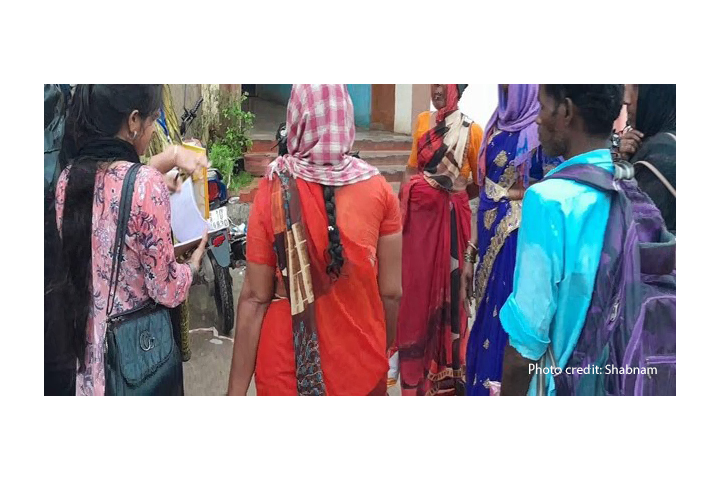
In the year 2025 I had the privilege of conducting fieldwork in a minority settlement – ‘Noor Nagar’ (pseudonym). It was not merely a field experience, but also an emotionally-moving journey. Conversations with students and parents reminded me that for the marginalised section of society, education is not simply about degrees or employment opportunities. It is deeply connected with dignity and social transformation.
The most touching experience was listening to the stories of young students and their parents. Despite being engaged in some of the most difficult and invisible forms of labour, including street vending and rickshaw pulling, many parents remain determined to educate their children. With limited resources, countless hardships and very little social support, they continue to strive for a better future for the next generation. They are unwilling for their poverty to determine the destiny of their children.
This fieldwork sought to understand educational inequality and its intersection with identity through an engagement with the everyday lives of a marginalised community. These spaces carry stories of resilience, endurance and courage amid conditions of socio-economic precarity. Entering the field was not merely engagement with a geographical space, but an encounter with lives shaped by the continuous negotiation of dignity, educational deprivation and limited opportunities.
Accessing the field
Access to the field was facilitated by the Charitable Health Centre, an NGO working within the community, which provided a more respectful and ethical entry into the settlement. This experience taught me that fieldwork is never entirely neutral, that access is negotiated through existing relationships of trust, institutional legitimacy and pre-existing power structures. Without such support, entering the community may have been considered an intrusion. Thus, I entered the field not only as a researcher but also as a transitory actor in a shared social field, in which my presence was negotiated through the trust attached to the health centre. But access to the field was much more than a formal consent process. This meant spending time in shared spaces, waiting in narrow corridors, and using informal gathering points allowing signs of recognition, familiarity and acceptance to emerge. Conversations were slow to develop, through long stays, interactions, hesitations and some refusals. These experiences revealed that it was not a straightforward process of data collection, but a constant negotiation of presence, relationality and belonging in the community. These interactions over time enabled a closer engagement with residents’ lived realities, gaining insights into the everyday experiences of exclusion, educational inequality and socio-economic marginalisation that influence community life.
My positionality
I entered the field as a female doctoral researcher, and my identity shaped both my access to and interactions within the community. Participants often mentioned that sharing the same religious background fostered a sense of familiarity and trust, particularly among women participants. However my academic status, urban background and institutional affiliation simultaneously marked me as outsider. This insider-outsider dynamic remained central throughout the fieldwork. Although prolonged engagement and informal interactions gradually fostered rapport, they also revealed the unequal social realities which shape relationships. I could move freely across spaces, unlike many residents whose everyday lives are negotiated within constrained social and economic conditions. These experiences highlighted how class, mobility and educational privilege often play a more significant role in shaping field relations than shared cultural identity alone. Fieldwork therefore, emerged not only as a process of data collection but also as a reflexive engagement with questions of power, representation and positionality.
 |
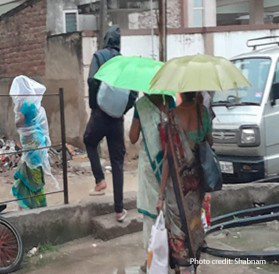 |
When I reached the settlement, it was raining heavily. Water had accumulated in many of the narrow lanes and the drains were overflowing. Yet life continued without interruption. Women walked carefully through the mud, lifting their saris slightly as they carried groceries and bags. The rain revealed how neglected infrastructure affects mobility, safety and dignity in everyday life.
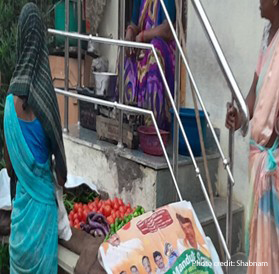
One of my first conversations was with an elderly woman selling vegetables from her doorstep. Looking at me, she smiled faintly and said, “You people come to write. What changes for us?” Her words reflected a broader concern often seen in marginalised communities where researchers and officials come, collect stories and data, and leave, with little changing in people’s lives. That interaction made me reflect deeply on my own role, ethics and responsibility as a researcher.
In that moment, I realised that suspicion in marginalised spaces is not hostility; it is memory. Many researchers, journalists and officials had entered the community before, documented lives, collected information and moved on. Yet meaningful change often remained slow or absent. I honestly explained who I was, my purpose and my limitations. I did not pretend to represent authority or promise transformation. Over repeated visits, familiarity slowly grew.
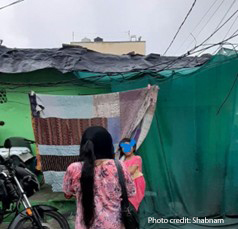
Being a woman allowed me to enter homes and speak more freely with girls. I noticed that one small room often served as a kitchen, workspace, sleeping area and children’s study space at different times of the day. These experiences showed me that educational inequality cannot be separated from living conditions and access to resources. Conversations with girls revealed how education was shaped not only by poverty but also by safety concerns, family responsibilities and social expectations. While boys were encouraged to imagine independence and opportunities outside the settlement, girls often had to balance their aspirations with caution and duty.
The fieldwork also reminded me that marginalised communities are often represented only through poverty. However, the people I met had humour, resilience, emotions, dignity and agency that are often missing from academic discussions.
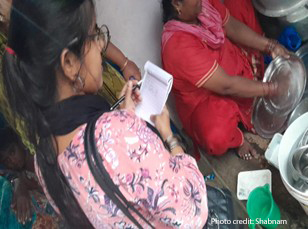
One afternoon, a child watching me write in my notebook asked, “Are you a teacher?” When I replied that I was a student, she looked surprised. In that moment, I felt both close to and distant from the community. I shared gender and faith with many residents, but not the same material realities. Some residents were also hesitant to participate. One man asked directly, “Many people come here. What is the benefit?” I listened and explained honestly that participation was voluntary and that I could not promise immediate change.
Trust did not emerge suddenly. It developed slowly through repeated visits, listening and everyday conversations. People began sharing concerns about children’s education, rising prices, health worries and work. One evening, a woman returning from domestic work smiled and said, “Now you feel like one of us.” That statement stayed with me because it showed that I was no longer seen only as an outsider. I was sometimes offered tea during visits. Once, a young man insisted on offering me homemade pickled vegetables without taking any money. I gently refused, but the gesture stayed with me because it reflected warmth, trust and dignity despite the difficult circumstances.
Over time, fieldwork shifted from extraction to relationship. What I could offer remained limited: listening, documentation, information and sometimes connecting residents with the NGO. I could not offer structural change or institutional power. That limitation was difficult to accept. The field also taught me that being an insider or outsider is never resolved. Shared identity may open doors, but structural differences continue to shape boundaries.
When I eventually left the field, I realised that the departure itself was emotionally difficult. Anthropologists call it “leaving the field”, but the field does not leave you. It stays in memory, responsibility and in the awareness that behind every dataset are real lives negotiated daily. I entered with a notebook and questions, but I left with humility and a deeper sense of responsibility to represent people with dignity rather than reducing their experiences to stereotypes or to academic material alone.
 |
 |
This field experience demonstrated that educational inequality cannot be understood only through statistics, policies and institutional frameworks. Rather, it is deeply embedded in the lived realities of marginalisation, economic insecurity, gendered responsibilities and unequal access to opportunities. For many residents, education represents not only employment and mobility but also dignity, identity and hope for a better future. The field also compelled me to reflect on my positionality and reminded me that fieldwork is not merely the act of collecting data; it is an interactive relationship influenced by both power and privilege.
Ethical clarification
All photos used were obtained with the informed consent of all participants.
Acknowledgement
The author expresses sincere gratitude to the NGO facilitating access to the field. The author is also deeply thankful to all the participants for generously sharing their experiences and time during the field visit.