This blog was written by Tooba Noor and Ali Nawab. For the 2025 UKFIET conference, a record 37 individuals from 15 countries, including Tooba, were provided with bursaries to assist them to participate and present at the conference. The researchers were asked to write a short piece about their research or experience of attending the conference.
Education in emergencies
Emergencies continue to pose a significant global concern as they lead to unpredictable events and consequences, adversely affecting regions across the world. From natural calamities to pandemics, political turmoil and conflicts, emergencies can destabilise social, economic and political systems, resulting in substantial fatalities and material destruction. Education remains to be the most impacted area during these emergencies, as educational systems lack mechanisms to resist and successfully encounter the recurring crises. This also exacerbates the prevailing marginalisation in educational contexts during and after crises. To reinforce the delivery and connection of education, the term ‘education in emergencies’ was coined during the 1990s to emphasise education as a fundamental component of humanitarian operations during crises.
The 2022 Pakistan floods constituted one of the most severe climate-induced humanitarian crises in the country’s history, affecting an estimated 33 million people nationwide. It caused widespread destruction of houses, infrastructure and livelihoods, pushing already vulnerable communities into deeper insecurity. The education sector was hit severely hard. Approximately 30,000 schools were damaged or fully destroyed, disrupting learning for more than 3.5 million children. As a result, the prolonged school closures not only interrupted formal education but also exposed children to heightened risks, including child labour, early marriages and permanent dropout, as families struggled to cope with economic losses. To address the crisis and minimise the loss, the Government of Pakistan formulated various solutions to meet the educational requirements of children impacted by emergencies. One of solutions involves the creation of Temporary Learning Centres (TLCs).
Temporary Learning Centres
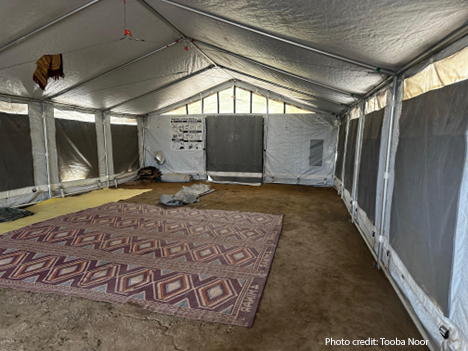
The TLCs, with UNICEF’s support, were established in response to the floods of 2010 and 2022 in the provinces of Sindh and Balochistan. These centres played a crucial role in restoring access and delivery of education to thousands of children. More than 1,300 TLCs were established that served 70,000 children in impacted regions in the country. Establishing such an educational avenue is often the first step in restoring education during emergencies. Understanding how these spaces actually influence learners’ academic continuity and emotional wellbeing remains equally important. Therefore, we conducted a study to explore the potential of TLCs as an alternative learning model in a crisis setting.
Methodology
The study employed case study research design. The data were collected from one of the most affected regions of Sindh, namely, Khairpur. To develop an in-depth understanding of the impact of TLCs, a variety of stakeholders were consulted – specifically a UNICEF representative, two government officials, twelve TLC teachers, five TLC leaders and fifteen parents. Data were generated through semi-structured interviews and focus group discussions supported by the analysis of documents including curriculum and learning resources.
Findings
Stakeholder engagement
Unlike traditional schooling, where the government is considered the sole provider of access to education, the TLCs were established through collaboration of various stakeholders, including international aid agencies (like UNICEF), government and local bodies. Coupled with these centralised bodies, parents and communities played an active role in ensuring the delivery of education during the crisis. This shared ownership highlights that effective stakeholder engagement and partnership is essential and possible for the continuation of education in emergencies, especially to sustain the process of learning.
Curriculum and teaching
These TLCs offered a multi-subject curriculum and multi-grade teaching setting, where the students of different ages were grouped together and learnt various subjects, such as Sindhi, English, Math, Islamiat, Urdu, Social Studies and Science. This format of education employed in TLCs encouraged and reinforced peer learning. Moreover, unlike the traditional practices, the curriculum in these settings was condensed to cover the important or essential topics which were taught using a variety of pedagogies and co-curricular activities for psychosocial well-being. This format of education resulted in notable child development improvements in communication, hygiene and confidence among students.
Successes
All stakeholders shared their satisfaction with these TLCs in providing immediate access when education in normal schools was disrupted. It provided accessible and safe learning spaces during displacement. These TLCs served as an avenue to maintain educational engagement and psychosocial wellbeing. As a result, children showed improvements in academic and social dimensions, along with improved confidence. These centres emphasise the notion that, in emergency contexts, education can be both a source of learning and a space of healing for those who are most affected.
Challenges
Although the TLCs were effective in various ways, there were also certain challenges undermining their impact. These challenges included infrastructure issues such as space, furniture, electricity and other material resources. TLCs were viewed as temporary and less formal compared to regular schools and that affected their value and potential contribution. The sustainability and the long-term funding to maintain such spaces was found to be an additional challenge – it was quite challenging to sustain the engagement of all stakeholders.
Conclusion
This study concluded that the establishment of TLCs is an effective route to continuing education in times of emergency and crisis. Such spaces have demonstrated their effectiveness in promoting collaboration among stakeholders as the key highlight. The greater the collaboration among stakeholders, the higher the chance of success, and vice versa. The TLCs reinforce the ecological and multi-sectoral approach to education in which not only education, but also health, hygiene, wellbeing and psychological support are ensured. The findings of this study also highlight the effectiveness of multi-grade teaching as an effective teaching and learning model for emergency situations. Therefore, teacher education programmes must include multi-grade teaching as an essential skill to master, in preparation for an uncertain future. Finally, longitudinal research and comparative studies on different education models other than TLCs employed in emergency situations are recommended to understand the impact and effects of these centres.