This blog was written by Dr Alvin Leung, Senior Impact Evaluator, and Dr Brigita Séguis, Head of Impact Evaluation, Cambridge University Press & Assessment.
Introduction
Effective language teaching in emergency and marginalised contexts requires more than grammar instruction. It demands pedagogical approaches that build communicative competence, develop life competencies and create safe learning environments for traumatised learners.
This article examines three interconnected pedagogical dimensions of the Global English Language (GEL) programme, an initiative that has served more than 32,000 learners across 100 centres in more than 30 countries. Drawing on evidence from a comprehensive evaluation of the GEL programme, we explore how the following collectively transform language learning for refugees and displaced persons affected by conflict: (a) use of the communicative approach; (b) integration of life competencies; (c) use of trauma-informed pedagogy, supported by recruitment of teachers from local communities.
Background
Since 2017, Jesuit Worldwide Learning (JWL) and Cambridge University Press and Assessment (Cambridge) have collaborated to deliver the GEL programme. JWL implements the programme and provides facilitators with training, while Cambridge supported the programme with teacher training, learning materials and exams, with over 30,000 Cambridge English tests taken as of mid-2026. GEL courses are generally offered at no charge to learners, who are typically responsible only for a minimal share of the operational expenses. The evaluation of the GEL programme took place in 2025; it analysed more than 4,000 survey forms and conducted interviews with facilitators and learners in Kenya and Iraq.
Operating in refugee camps, post-genocide communities and remote areas affected by conflict and poverty, the GEL programme recognises that English proficiency is a critical barrier preventing access to higher education and professional opportunities for the world’s most marginalised populations. In response, the pedagogical design of the GEL programme employs the following three interconnected pedagogical approaches.
Communicative language teaching: Group work and authentic speaking
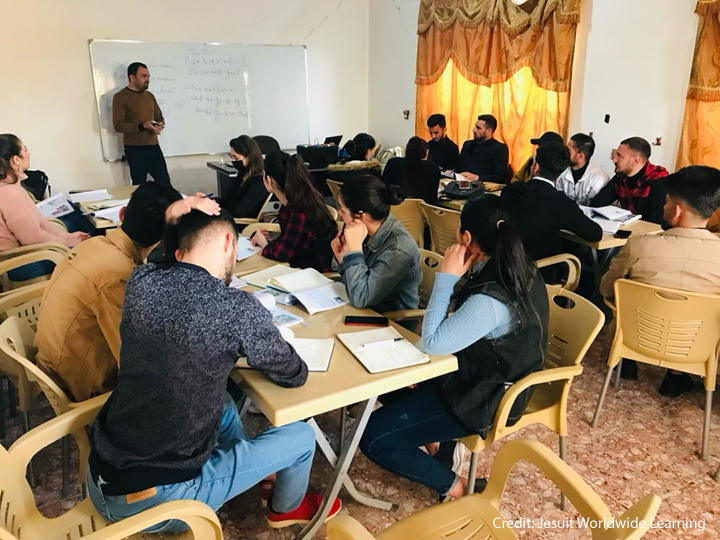
The cornerstone of GEL pedagogy is communicative language teaching (CLT; see this book chapter by Sandra J. Savignon), with particular emphasis on group work and authentic speaking practice. Rather than prioritising grammatical accuracy through translation exercises and memorisation drills (which were common in the more traditional grammar-translation method), GEL learners engage in group discussions, opinion-sharing activities and presentations.
The evaluation found that GEL learning differed from learners’ prior experiences. Many participants had attended traditional grammar-focused English classes in formal schools in their home countries and/or in refugee camps. One student in Iraq reflected, “back in schools, we just studied for the exam, not for speaking, and it did not help us learn English.” In these earlier contexts, speaking practice was limited, and learners had limited experience of authentic conversations.
GEL transforms this dynamic through deliberate pedagogical structuring. Facilitators, trained by JWL, embed extensive small group speaking activities in their lessons. This was supported by Cambridge’s coursebooks that explicitly structured around pair and group work for authentic communication. GEL learners in Kakuma refugee camp in Kenya and Sinjar in Iraq reported substantially increased in-class speaking time compared to prior English-learning experiences. One student in Iraq recalled, “I was very shy before I entered this course… The teacher gave me the push to speak all free and do not feel shy and be powerful.” Another learner noted the direct impact, “I’m really grateful for this course because it gave me the confidence to myself to talk without being worried about making mistakes.” Ninety percent of student respondents to the evaluation survey in the two countries agreed that GEL increased their confidence to interact with others in English.
The pedagogical shift prioritises functional fluency and confidence-building, enabling learners to develop practical language skills rapidly. For refugee populations with interrupted education histories, this shift from passive learning to active communicative participation addresses a significant learning gap.
Life competencies: Critical and creative thinking in language learning
Effective language instruction in marginalised contexts must develop more than communicative fluency. Learners need what educators call ‘life competencies’, that is, the knowledge, skills and attitudes required to participate in study, work and community life. GEL integrates valuable life competencies from Cambridge’s Life Competencies Framework, including critical thinking, creative thinking and collaboration. These are not taught as separate units but emerge through language tasks and classroom interactions.
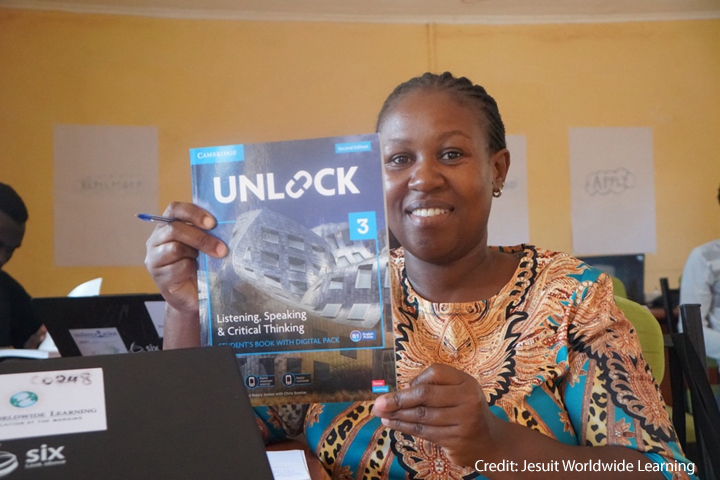
The coursebooks, provided by Cambridge, are central to this integration. They present substantive topics (e.g., globalisation, science, environmental challenges, ethical dilemmas) that require learners to engage intellectually with content. In classroom discussions, facilitators structure small group activities in which students analyse texts, post questions, clarify meaning and justify interpretations. This simultaneously develops language and critical thinking skills.
Independent study further reinforces this integration. Many learners spend study time preparing speaking presentations on assigned topics. This preparation demands creative thinking, supported by research, synthesis and structured reasoning. Also, collaboration runs through this pedagogical model, with learners working together to support one another’s comprehension, explain concepts and coordinate contributions toward shared goals.
For many refugees and displaced people, English proficiency constitutes a primary barrier to tertiary education. Evaluation data indicate that a large proportion of GEL learners enrol to access further studies. By embedding life competencies in its lessons, GEL courses help learners succeed in higher education, which usually requires competencies for critically understanding academic texts, giving presentations and completing group assignments. One student reflected, “back in university when I had seminars and presentations, I was not confident with my English because we presented in English. But after I took the GEL course, I am now more confident.”
Many adult GEL learners enrolled to secure employment or advance in existing positions. The evaluation found that 72 percent of recent graduates in the two countries reported that GEL had helped them secure employment, improve job prospects or evolve professionally. When language instruction is organised around realistic communicative scenarios and development life competencies, learners directly connect academic effort to life and career goals.
Trauma-informed pedagogy and power of locally-recruited facilitators
Language education in refugee camps and post-conflict communities must acknowledge that many learners carry severe psychological trauma. Effective teaching creates conditions for both learning and healing. Trauma-informed pedagogy creates psychologically-safe learning environments where mistakes become opportunities rather than sources of shame, where learners experience agency and control, and where peer support and community are cultivated (see article by Aleks Palanac for more on the pedagogy).
The GEL programme operated along the principles of trauma-informed pedagogy. At community learning centres in Iraq and Kenya, facilitators deliberately create psychologically-safe spaces. One learner in Iraq reflected, “facilitators treat us with kindness and respect. […] This creates a great learning environment where we all feel supported.” The International Rescue Committee’s Healing Classrooms approach similarly demonstrates how teachers can create safe spaces where refugee children learn and heal.
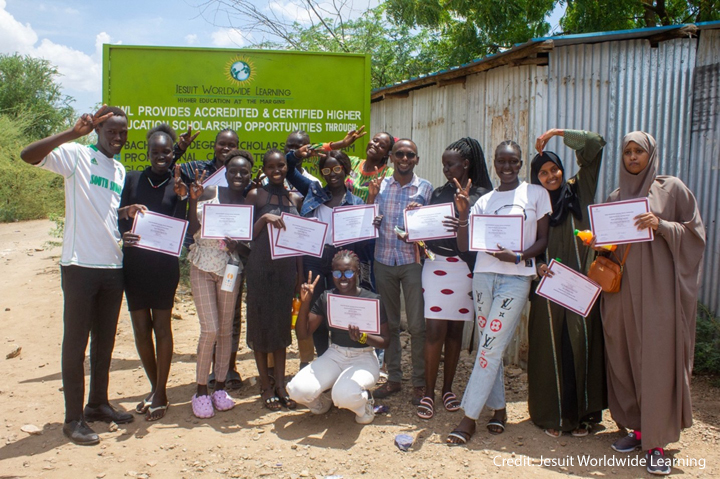
A critical element of this approach is local recruitment of facilitators. When facilitators are drawn from the communities they serve, they bring irreplaceable understanding. In Iraq, Yazidi facilitators understand the context of their students’ experiences. In Kenya, some facilitators in Kakuma refugee camp are themselves refugees who have navigated displacement. This shared experience creates authentic empathy. Moreover, locally-recruited facilitators serve as role models of resilience. When learners see facilitators who share their background, it demonstrates that recovery and advancement are achievable.
JWL’s investment in facilitators’ professional development amplifies these advantages. Facilitators receive initial orientation, engage in peer mentoring and access ongoing professional development. This support system ensures that locally-recruited facilitators are culturally grounded and professionally skilled.
Conclusion and implications
GEL demonstrates that ambitious pedagogy is possible in refugee and emergency contexts. The programme shows that communicative teaching, life competencies and trauma-informed practice can co-exist in a single language programme when design decisions, materials and facilitation are aligned and match learners’ needs.
For language educators in marginalised contexts, several lessons stand out:
- Structuring lessons around group work and authentic speaking is a necessity where learners have limited time, fractured schooling and urgent needs to use English.
- Integrating critical and creative thinking into course content builds learners’ capacity for the cognitive demands of higher education and employment.
- Recruiting and supporting facilitators from local communities makes trauma-informed pedagogy more credible and sustainable because empathy, cultural knowledge and role modelling are built into the system.
The broader implication is that language education in emergencies can simultaneously build linguistic, cognitive and socio-emotional capacities if they are intentional about pedagogy, materials and facilitator development from the outset. While this evidence comes from Kenya and Iraq, these pedagogical principles apply across refugee camps, post-conflict communities and marginalised contexts wherever language education occurs.