This blog was written by Nigusse Weldemariam Reda, Dean of the School of Education Sciences, Mekelle University, Ethiopia; and Rafael Mitchell, Co-Director of the Centre for Comparative and International Research in Education, University of Bristol, UK.
There is very limited international awareness of the crisis affecting over 6 million people in Tigray, Ethiopia. The Civil War (2020-2022) has led to economic collapse, mass displacement and widespread trauma and hardship across the region. The impact on education has been catastrophic.
In 2023, schools started reopening after 3½ years of closures due to the pandemic, war and blockades. However, political tensions have continued, with funding disputes over the last year leading to the closure of schools across the region. As of June 2026, an estimated 2.4 million children are unable to access their right to education under Article 26 of the Universal Declaration of Human Rights.
During and since the war, researchers from Mekelle University have been working with the Tigray Regional Education Bureau and others to provide evidence to inform regional responses to the crisis. Mekelle University’s School of Education Sciences is emerging as an important centre for research on education in emergencies, and has partnered with the University of Bristol in the UK to explore different aspects of post-war education recovery.
A new open access article in Compare illustrates the role of local researchers in providing evidence and advice to inform middle-tier decision-making around the re-opening of schools in 2023-4. As this study shows, university-based researchers have a key, but overlooked, role in knowledge production and exchange for responding to crises based on local knowledge, priorities and institutions.
This article describes a radical effort to compensate for extended school closures through the introduction of an Accelerated Education Programme (AEP) across all primary and secondary schools in the region. AEPs are generally praised for their inclusive pedagogies which improve attainment for disadvantaged learners; however, the Tigrayan initiative was ‘an AEP on a shoestring’, bearing little resemblance to other initiatives in terms of pedagogy or outcomes. Evidence produced by Mekelle University illustrated widespread quality concerns, and growing inequalities between high achievers and the majority of learners. This report led the Tigray Regional Education Bureau to adopt a more flexible, differentiated approach based on local conditions, rather than a blanket AEP across all schools in the region.
The second new study, to be published by the British Council later this year, explores the working conditions of primary school English teachers in 2025-2026. This is the first major effort to explore the effects of the war on the social world of schooling, based on interviews with 60 teachers in urban and rural settings.
The study finds a stark deterioration in school conditions. There is widespread trauma and hardship amongst teachers and learners. Enrolment and attainment have collapsed, as has the popular belief in schooling as a means of individual advancement. While teachers feel a deep responsibility for their work, they lack appropriate professional support and remuneration. Only a small minority of learners are meeting the academic objectives of schooling, and most are not receiving their educational entitlements.
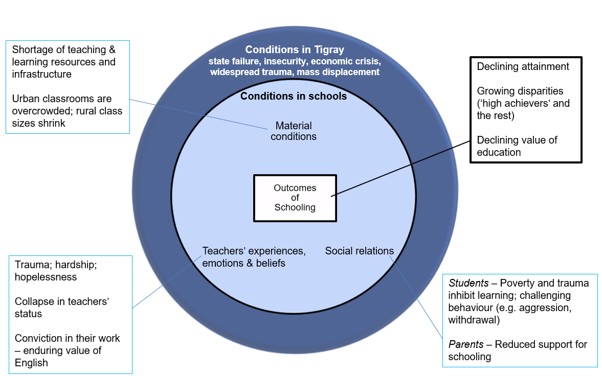
While previous studies have documented direct violence against educational infrastructure and personnel during the Civil War, this new research shows that unresolved political tensions in the post-war era have led to the neglect of public welfare, infrastructure and provision. As such, pragmatic, technical solutions cannot address the current educational challenges, and solutions are needed in the political domain.
International recognition of the crisis and solidarity are needed for post-war reconstruction of education in Tigray, Ethiopia. Urgent action is needed to ensure that children in Tigray are able to access education, and improve the livelihood of teachers who are living in poverty due to unpaid salaries.
- Restore funding for schooling in Tigray. Repeated disruptions to education funding since 2020 have led to widespread school closures and the loss of teachers’ livelihoods. Action is needed to ensure children in Tigray can access education in line with Article 26 of the Universal Declaration of Human Rights.
- Improve teachers’ livelihoods and professional support for teaching in this conflict-affected setting. Teachers’ salaries must be stabilised, and teacher education provision updated to incorporate Mental Health and Psychosocial Support and trauma-informed practice.
New publication:
- Policy–research partnerships for post-war reconstruction of education in Tigray, Ethiopia: the role of local university-based researchers by Nigusse Weldemariam Reda, Mulugeta Tsegai Gebre-eyesus, Haftu Hindeya Gebremeskel, Fesseha Abadi Weldemichael & Rafael Mitchell
Forthcoming:
- The working conditions of primary school English teachers in post-war Tigray, Ethiopia by Nigusse Weldemariam Reda, Rafael Mitchell, Desta Luel Tsegay, Eyorusalem Tsegay Ataklti, Fesseha Abadi Weldemichael, Haftu Hindeya Gebremeskel, Lewtnesh Berihun Dangew & Mulugeta Tsegai Gebre-eyesus