This blog was written by Joe Hallgarten, a teacher, education consultant and activist.
When I left full-time teaching after five years for the world of think tanks (after a brief layover at a teacher union) two things struck me in particular.
First, how much energy everyone seemed to have, especially in the late afternoons. After an exhausting day of teaching, I had become over-accustomed to post-4pm lulls, or even teatime naps.
Second, how my own limited – and often far from outstanding – teaching experience bought me far more credibility than I deserved. It was rare those days to meet anyone in think tank or government circles who had any kind of genuine frontline background. So having someone (i.e. me) in the room who had been in real classrooms with real children was seen as (fools’?) gold dust. I was both embarrassed by this strangely elevated status, and made the most of it.
My groundedness also did not serve me well in that world. In places whose currency was smart, rapid-fire policy ideas, I felt a built-in resistance to excessive, prescriptive ‘schools should/teachers should’ proposals. This scepticism probably never left me. In 2014, I suggested that schools should have a ‘gap year’ from new policies or even recommendations. More recently, I have been advocating for government to play a role as a ‘space creator’ so that schools can design and deliver their own missions.
Since then, in the UK at least, things feel positively different. Thanks to a number of forces – including the powerful presence of Teach First alumni and movements such as Research Ed and Rethinking Education – teachers and school leaders are better represented in various education-related organisations and fora. It is not perfect, of course, but is improving.
In contrast, I am also noticing an increasing trend in more global education circles for events to be virtually teacher-free. Maybe it was always thus; maybe I was, in my globally-facing research and consultancy days, simply blind to this issue; maybe my current part-time teaching role makes me especially acute and prickly about this.
To take just one week in April:
I watched a session organised by the Brookings Institute on Collaborative research and action to transform education systems. I could be wrong, but it looked like not one of the 35 people listed in the programme was a current school leader, let alone taught in the classroom The contradiction between the event theme and its participants feels obvious, and pernicious.
A Global Schools Forum event on Pioneering change: Aligning education innovation with the realities of government adoption had twelve speakers, none of whom seemed to have current (or possibly recent) classroom experience.
I also attended a Skoll Forum Fringe event on global education and purpose where over a hundred education stakeholder were participating. I didn’t talk to all of them, of course, but am pretty sure that none of them had taught that week, or possibly even this year.
Earlier in the year, I observed how at Davos, all education events (including one at the ironically-named ‘House of Trust’) were untainted by teacher voices.
I am of course not the only person to notice this absence.
Teacher and writer David Cutler’s Teachers on fire responded assertively to Brookings report ‘AI’s future for students is in our hands’:
“Teachers have been sounding the alarm since the moment generative AI tools landed in students’ hands. Yet, it often takes a major institution to ‘confirm’ what classroom teachers already knew — clearly and consistently — with thousands of corroborating examples. Brookings even acknowledges the timeline. Their Center for Universal Education has been investigating these questions since September 2024. That is the core of the credibility problem in education: Teachers can point to the injury while it is happening and still be treated as if they are offering mere anecdotes instead of expert testimony.”
At the 2022 Transforming Education Summit, Education International published a toolkit noting they were “currently investigating opportunities for an event by, for and with teachers in connection with the Summit” – essentially having to organise a parallel teachers’ event because the main Summit was not designed to include them as speakers.
And this is far from new: when the National Broadcasting Company (NBC) launched its ‘Education Nation’ summit in 2010, teachers mounted such a fierce backlash – including a rival ‘MisEducation Nation’ event – that NBC hastily added a token teacher panel, broadcast at noon on a Sunday during football season. If the same complaint continues to be made 15 years later and nothing has changed, that itself is worth naming.
I am also noticing one other event trend – globally and nationally. No event now seems complete without some kind of youth voice and presence. Often performative and tokenistic, carefully selected young people are given a tight space to articulate their views. Even with this, no education conference seems to happen without someone saying something faux clever about “why are there so few young people in the room?”
I am not trying to pit the voices of young people and teachers against each other. There should be space for both. But nobody ever asks “where are the teachers?” with anything like the same urgency. Right now, event organisers are prioritising youth over teachers – and very few participants seem to notice, let alone mind.
Of course, events are just events. There are many other ways in which teachers’ voices can be included, excluded or simply neglected in education debates and policy formation. Teachers are busy in front of kids and even with enough time and probably some payment to the school, it is not always easy to get away.
I am also not trying to privilege teacher voices over others. Yes, we have some practical wisdom to bring to bear, but it can also be tricky for us to see the big picture, to think before acting. Our pragmatism can be a limitation.
I am also not one to criticise an opinion just because it comes from the mouth or keyboard of a non-educator. The voices who have never taught have both a right and a value, not just because ‘we have all been to school’ but because we are all taxpayers, so we have a right to a say on how our education money is spent. External perspectives can be useful (as I hope my GP partner can testify, when I come up with yet another daft idea about how to improve the state of our National Health Service).
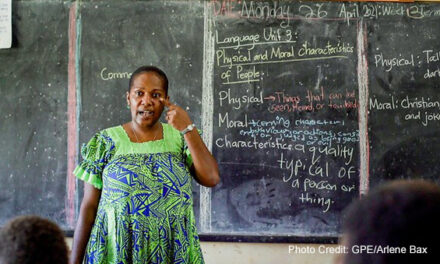
But any thinking about education that excludes or neglects teacher voices is likely to suffer in both quality and buy-in – and those running these events should know this. Instead, these events could be a good starting point to challenge and change norms about teacher voices.
My view is that education events where the programme line-up is teacher-free should be as unacceptable and anachronistic as the now largely-absent female-free conferences and panels that used to be so frequent in all sorts of events.
It is time for more of us – teachers and non-teachers alike – to call this out. The norm should be simple: no education event without at least one practising teacher speaking on the programme.
We could refuse to participate in events or panels that do not include teachers. We could do some polite ‘naming and shaming’.
We would be doing event organisers a favour. The political philosopher Bernard Crick once warned that think tanks risk having ‘their feet planted firmly in the air’ – confident, well-funded and untethered from reality. Without teacher voices, that is exactly where too many education events are headed.