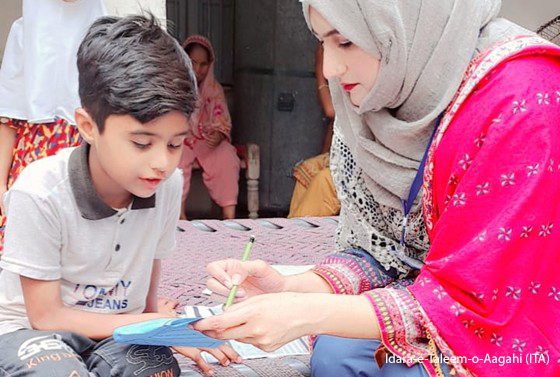
This blog was written by Sehar Saeed, Deputy Director Research, Idara-e-Taleem-o-Aagahi (ITA), Pakistan.
Over the past few weeks, much of the education discourse in Pakistan has centred on one question: how many children are out of school? The debate – driven by comparisons across datasets – has drawn attention to differences in estimates and methodologies.
But in focusing so heavily on how many children are in school, we risk overlooking a far more urgent and pressing question: what are children actually learning?
Recent evidence from ASER 2025, suggests that over 90% of children aged 6–16 are enrolled in school across Pakistan, with out-of-school children estimated at under 10%. While differences remain across datasets (Pakistan Social and Living Standard Measurement Survey-PSLM), emerging evidence from latest round of ICAN ICAR – a nationally representative survey – points toward a broadly consistent pattern of high and improving enrolment. This is, without doubt, an important achievement.
ICAN–ICAR (2025), developed under the PAL Network, represents an independent, citizen-led international effort to generate comparable evidence on foundational numeracy and reading across the Global South. The release of its microdata on the DataFirst portal at the University of Cape Town strengthens transparency, replicability and open scientific engagement.
However, enrolment is only the first step, not the destination.
ASER 2025 findings present a stark picture. Only 7% of Class 3 children can read a simple story in Urdu/Sindhi. Just 10% can read basic English sentences, and only 8% can perform division.
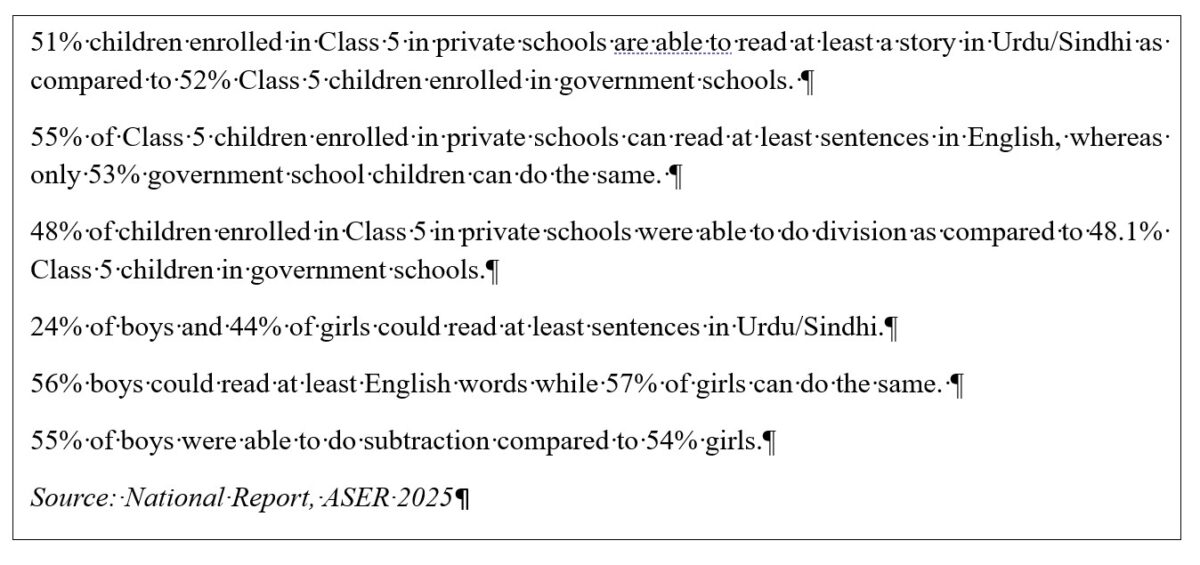
Even by Class 5, only about half of children (51% and 54% respectively) can read a Class 2-level text (in Urdu/Sindhi and English), and 48% can do basic division. These are not marginal gaps – they represent a systemic learning crisis.
What is perhaps more concerning is that there are no easy explanations or escape routes. Learning outcomes are nearly identical across government and private schools, suggesting that the issue is not confined to one segment of the system. Girls are performing as well as, and in some cases better than, boys, indicating that access and gender are no longer the central constraints. The challenge is deeper—it is about the overall quality of learning.
At the same time, households are adapting in ways that reveal the system’s limitations. A significant proportion of children – 44% in private schools and 24% in government schools – are relying on paid tuition. Multi-grade classrooms remain common, particularly in government schools (30% of the surveyed government schools had Class 2 sitting with other classes), where a single teacher often manages multiple grade levels simultaneously. These are not isolated issues; they are signals of a system under strain, where families are compensating for gaps that schools are unable to fill.
What emerges is a troubling reality: Pakistan has made progress in getting children into schools, but schooling is not translating into learning. We are, in effect, witnessing high participation in a low-learning system. This has profound implications – not just for education, but for the country’s future workforce, productivity and social mobility.
As the Sustainable Development Goals approach their final stretch, the global conversation is shifting from access to learning outcomes. Pakistan stands at a critical juncture. If we continue to measure success primarily through enrolment, we risk missing the deeper crisis. But if we shift our focus to learning, there is an opportunity to reset priorities and rethink systems.
The question is no longer whether children are in school. The real question is whether they are learning enough to build their futures.
The evidence is clear: Pakistan’s education challenge is no longer just about getting children into classrooms – it is about ensuring that classrooms deliver learning. This requires a shift from input-focused metrics to learning outcomes, renewed attention to foundational literacy and numeracy, and a closer look at what is actually happening inside classrooms. It also means recognising the ways in which households are already responding to system gaps – and addressing the root causes behind them.
The debate on out-of-school children is important, but it should not distract us from the larger reality. Pakistan may be closer to solving the access problem, but it is still far from solving the learning crisis. This is precisely why ASER, as a citizen-led assessment initiative and one of the approaches recognised and validated (2025) under the Copenhagen Framework approved by UNSD, has consistently placed foundational learning at the center of the national conversation for over a decade, continuously highlighting that access alone is not enough unless it translates into meaningful learning outcomes.
Ultimately, it is and will always be learning that will determine the country’s future.