This blog was written by Laud Ebenezer Freeman, PhD student in the Faculty of Wellbeing, Education and Language Studies (WELS) at The Open University.
Across the Global South, significant progress has been made towards expanding access to education for learners with disabilities. Inclusive education policies have increased opportunities for children who were previously excluded from mainstream schooling to learn alongside their peers. However, the important question that remains is what happens beyond access?
This distinction between access to schooling and access to learning is important because presence does not automatically mean meaningful participation. It is particularly important in STEM education, where concepts are frequently communicated through diagrams, demonstrations, graphs, equations and other visual representations.
As part of my PhD research on curriculum adaptation in STEM education for students with visual impairments (VI) in Ghana, I have been exploring how teachers adapt the curriculum, the challenges they encounter, and how students with VI experience STEM learning in both special and inclusive schools. An important issue that emerged concerns the role of sighted students in supporting their peers with VI to access learning.
Access mediation through peers
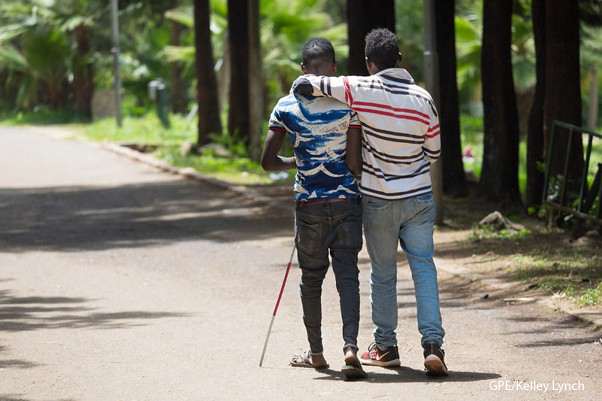
In inclusive classrooms, students with VI depend considerably on their sighted classmates to access instructional content. These peers, often called readers, assist their classmates with VI by describing visual materials, explaining classroom demonstrations, reading notes aloud and helping with other learning activities. Therefore, the term ‘reader’ is a general description for the types of support that sighted learners provide to their peers with VI. This support reflects one of the values of inclusive education, which is the development of social relationships characterised by empathy, respect, cooperation and mutual support.
However, classroom observations conducted during my fieldwork in the inclusive school suggest that these peer support arrangements can be fragile and, at times, shaped by other factors beyond the control of students with VI.
When inclusion depends on informal support
During STEM lessons, access to learning often depended on whether readers were available, willing and able to provide support at a particular moment. At times, support was suspended or delayed because readers were focusing on understanding the lesson themselves. In other instances, reader support became inconsistent for reasons unrelated to teaching and learning. For example, on a particular day, a reader decided that they did not feel like sitting next to their peer with VI. The student with VI sat through the maths lesson without the help of his reader. As a result, he had challenges understanding the lesson.
These observations highlight a subtle but important reality: readers are not teaching assistants. They are learners navigating the same curriculum demands as every other learner. While they may often be willing to help their peers with VI, they must simultaneously manage their own learning needs. Naturally, they prioritise their own learning needs. Moreso, they cannot support their peers with VI to understand a concept if they do not understand it themselves.
This contributes to a situation where learning for students with VI can become dependent on factors that are difficult to predict or control. Reader support may or may not be available, depending on factors such as the topic, timing, convenience, classroom dynamics, competing academic demands or individual relationships between students. This raises an important concern because if access to learning support depends considerably on sighted peers rather than accessible pedagogy and institutional support, participation in learning for students with VI becomes vulnerable to disruption.
The limits of enrolment-based inclusion
This situation points to a broader challenge. Educational systems often measure inclusion through quantitative indicators such as enrolment, attendance and placement of learners with disabilities in mainstream schools. While these are important, they may not necessarily reveal whether students with disabilities engage meaningfully with learning. A student with VI may be physically present in a STEM classroom but excluded from learning activities. The distinction matters because inclusion is not simply about where students learn; it is also about how they meaningfully participate in learning.
Rethinking support in inclusive STEM classrooms
The situation points to the need for a more intentional approach to supporting learners with VI in STEM. Inclusion should not be simply understood as access to classrooms, but as access to equitable opportunities for meaningful participation. Teachers require practical preparation and support to make STEM content accessible, particularly when teaching concepts heavily involve visual representations. This includes developing skills in verbal description, adapting learning materials and designing lessons that minimise visual barriers.
Readers, on the other hand, play an important role in supporting their peers with VI, but the primary responsibility for ensuring access to learning does not rest on them. Schools need to provide greater structure for peer-support arrangements through training, clear expectations, monitoring and recognition of students who take on these responsibilities.
From access to participation
These observations highlight an important consideration for inclusive education in the Global South. Expanding access to schooling is a significant achievement, but that alone is not enough. As countries continue to advance their inclusive education agendas, more attention must be paid to the conditions that enable meaningful participation in learning. Without addressing this, students may be ceremonially included in classrooms yet remain excluded from meaningful learning engagements. The challenge, therefore, is not simply to ensure that learners with disabilities are present in schools. It is to ensure that they can fully engage with what happens inside the classrooms. This may be one of the most important tasks facing inclusive education today.