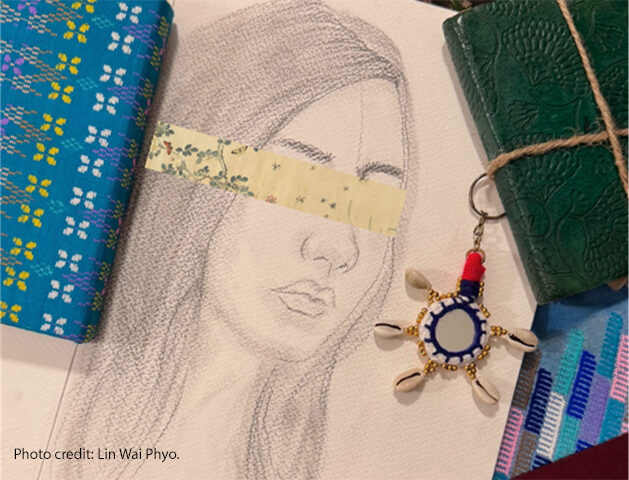
This blog was written by Lin Wai Phyo, PhD candidate at the Faculty of Education, University of Cambridge, UK. For the 2025 UKFIET conference, a record 37 individuals from 15 countries, including Lin Wai, were provided with bursaries to assist them to participate and present at the conference. The researchers were asked to write a short piece about their research or experience of attending the conference.
Thiri. That’s not her actual name. She chose it because it symbolises glory.
Thiri grew up in a hilly rural area, somewhere in the central plains of Myanmar. There, from a very young age, she was moulded by the unspoken societal expectations to take care of her family, look after the farm, and not imagine anything further. Life beyond her village only existed through films and television shows. In one of the Burmese legal dramas, she saw a woman using her voice to speak up for those unfairly convicted. She aspired to be like her. She wanted to be a lawyer. She dedicated herself to her studies, aced her matriculation examination, and secured a seat at a highly regarded public university in a distant city. Thiri was one of only a few students from her village to do so.
Then the Covid-19 pandemic forced campuses to shut down, compounded by the military coup which catapulted the country into upheaval.
Ever since the coup in 2021, Thiri has been at the forefront of the anti-coup revolution. Today, she continues her studies online, albeit plagued by setbacks, within the confines of what she called the Land of Freedom, while remaining committed to her resistance work. “I’m getting older and still haven’t completed my bachelor’s.” Thiri was in the final year of law school when the coup started. What began as a fleeting anti-coup movement has mutated into years of constant political struggles. “I have no regret dedicating my life to this fight. But the longer I stay in this revolution, the more I realise the need to change the system from within. That’s where education comes in.”
Learning without walls
Following the 2021 coup d’état, Myanmar’s higher education has been mired in political unrest. Public universities eventually resumed their operations, yet the attendance is relatively low, with students and academics living under the thumb of stringent control and surveillance. Meanwhile, several students and academics, unfazed by the arrests and persecution, continue to boycott these military-controlled public universities, participate in the Civil Disobedience Movement (CDM), and some even join the anti-coup resistance movement. In response to such defiance, as well as mounting defeats by ethnic insurgents and anti-coup forces, the junta has introduced mandatory conscription service, not only forcing students to join armed forces but sacrificing their futures on a frontline war.
And yet, education, albeit fragile and precarious, endures.
Students try to opt for online learning, community-led initiatives and in-person courses offered across borders. These alternative pathways, often marred by internet disruptions and security concerns, become a refuge for the survival and existence of education beyond the reach of the junta. Yet, they are often uncertified, less recognised and not globally accredited. In a world where certificates and degrees act as currency, how do we expect students trapped in conflict-ridden settings to prove their knowledge? Education for them is no longer about credentials, but an act of survival and defiance against those who refuse them one.
What seems to be brushed aside
To the unknowing eye, tackling access issues, such as limited educational platforms, digital divide and lack of resources, becomes a priority to sustain educational opportunities in contexts fractured by conflict. These are all crucial and deserve focus. Yet, far more often, improving access alone does not grant inclusion. Would having a mobile phone with somewhat reliable internet connection enable students in Myanmar to learn online? The answer is yes, but if we stop here, we fail to consider other nuances which deny some from pursuing these educational opportunities.
Pursuing one’s studies clandestinely. Pseudonymising one’s names. Closing camera for security reasons. Experiencing constant fear of arrest. For Thiri and many students, this is what learning looks like.
Is learning taking place? Yes, but it comes with precarity, fear and most importantly requires courage. A simple test score, a language proficiency result or a certificate cannot capture these nuances. They assume everyone is on a levelled playing field, disregarding how conflict would have left some to struggle in the holes. For students trapped in armed conflicts, taking these tests may bring about personal dangers such as travel risks, military surveillance and digital exposure. Imposing these tests as a prerequisite to pursue and continue one’s studies not only questions fairness but raises ethical concerns.
An open invitation
Globally, widening higher education access has been a cornerstone of several policy reforms and initiatives by state and non-state actors including donors, international development agencies and universities. These efforts matter. They transform lives. Yet, we need to acknowledge how and where learning is taking place.
In Myanmar, alternative educational pathways[i] ensure the survival of education beyond the state’s control. Nevertheless, their long-term viability has always been under scrutiny: are they merely an interim solution for students? Will education they offer be recognised and accredited? Can they operate with limited and inconsistent sources of funding? Support is needed, ideally through collaborative efforts from various actors. Whether it is partnering with these alternative pathways, accrediting their courses, investing in teacher capacity, or raising awareness about these pathways, all are crucial to keep learning alive.
Let’s imagine a future together
Towards the end of our conversation, Thiri shares, “In order to liberate our country, we need different forms of contribution, whether on the battlefield or in the classroom. We are all playing a role.”
Thiri along with many other students in Myanmar are not waiting for education. They are already re-imagining one amid the ongoing political unrest and structural barriers that have failed them. They are doing their part. Now, the question is what can we do to contribute?
This blog is for Thiri, and many others who refuse to give up on education.
And for everyone who helps sustain and keep education alive.
[i] Some well-known pathways include the Spring University, Irrawaddy Law School and Parami Institute (Aung, 2023).