This blog was written by Vanessa Komiliades, Head of Professional Development – English and School Education, British Council.
This blog explores how education systems can respond more effectively to linguistic diversity through collaborative development of a language-responsive position.
Back in March 2024, UKFIET and the British Council brought together researchers, practitioners and policymakers in London to talk about language in education, viewing language as a fundamental aspect of education that shapes who can participate and learn. The workshop focused on the impact of the language used for learning, teaching, assessment and educational resources, and participants discussed their shared frustrations that often, too little attention is paid to language across the core components of an education system. This was relevant through all four discussion areas (assessment and evaluation, the socio-emotional aspects of learning and teaching, education in crisis contexts, and foundational learning and transitions between educational stages) and continued in the short blog series that followed, exploring each of these themes through a language lens. These deliberations demonstrated that language is central to learning: it affects participation, confidence, belonging and equity and shapes the extent to which education systems are able to support learners from diverse backgrounds to succeed.
That discussion then fed into a wider process and the British Council’s recently launched (May 2026) updated position paper on language-responsive education grows out of those conversations. This places language more firmly within debates about inclusion and equity. It also emphasises that decisions about language in education need to be grounded in local realities, recognising they are influenced by complex social, political, historical and economic factors. What started at that initial workshop in March 2024, was followed by a series of consultative events with policymakers, researchers and practitioners to inform the further development of the language-responsive position paper. These included British Council conferences on language in education in Nepal and Nigeria, a session at the ELINET conference in Oxford, and a workshop in France on Content and Language Integrated Learning.
Our updated position paper is not intended to add another new approach or framework to the discussion. Instead, it builds on established approaches, including but not limited to mother tongue-based multilingual education (MTB-MLE), Content and Language Integrated Learning (CLIL), and English-medium education (EME). The language-responsive framing offers a pragmatic perspective, recognising that different approaches do not necessarily need to be treated as mutually exclusive and can focus instead on how they may be adapted, combined and implemented, taking account of the complex network of factors influencing language in education decisions in different contexts.
The extensive global literature review underpinning the language-responsive position reinforces that learning outcomes are shaped not only by the language of instruction, but also by whether teachers are able to teach effectively in that language, whether learners have enough support to access the curriculum, and whether policy aligns with local linguistic and cultural realities. The findings from the global literature emphasise the importance of strong foundations in familiar languages alongside opportunities to develop a language of wider communication, such as English, whilst also highlighting that poorly supported transitions to a different language of learning and teaching can create real challenges for learning. These challenges can be all the more acute where teachers have had little chance to engage in meaningful professional development opportunities to develop their skills in terms of more language supportive pedagogy, and when quality provision of the new language (e.g. English) as a subject within the curriculum has not been prioritised in order to prepare learners for the transition.
The language-responsive perspective reflects that wider recognition of the centrality of language to learning. It does not advise which language(s) any particular country should use within their education system, and it does not offer any one universal model. It offers a way of thinking that is pragmatic and context-sensitive through encouraging decision-makers and education stakeholders to ask questions about what kinds of language support are needed across core components of the education system, how different approaches can work together and what support the students within the education system need in order to have equitable access to learning.
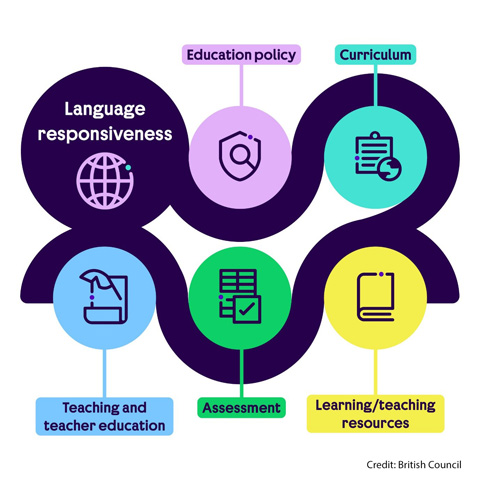
Language-responsiveness requires us to consider the whole education system, through curriculum, assessment, teaching, teacher education and learning materials as well as in policy. Where a potentially unfamiliar language such as English is used as a language of learning and teaching, in order to support learning, it is important that language policy decisions are accompanied by realistic planning, teacher support and professional development, appropriate materials and assessment that carefully considers language development. Where education systems are working to strengthen the use of home or familiar languages, similar considerations relating to planning and resourcing for training and teacher development, curriculum and assessment also apply.
One of the strengths of the language-responsive perspective is that it encourages us to keep asking important and practical questions. Who is expected to teach in which language? Which learners are likely to struggle or be most affected by language decisions? Are materials understandable for all learners? Do assessments give all learners a fair opportunity to demonstrate their knowledge? What support is in place for teachers and learners to implement policy decisions at school and classroom level?
Language-responsiveness in itself is not a particularly groundbreaking concept in some respects and could be perceived as being quite simple, but in the reality of implementation it can be extremely complex. The discussions that began at the UKFIET workshop in 2024 and continued throughout the development of the language-responsive position helped us to focus on the importance of considering language in every aspect of education, and the collaborative effort needed now is to encourage education stakeholders to embed this thinking about language and the associated questions into all decision-making and practice.