This blog was written by Erick Makhapila, Researcher at African Population and Health Research Center (APHRC), Nairobi, Kenya.
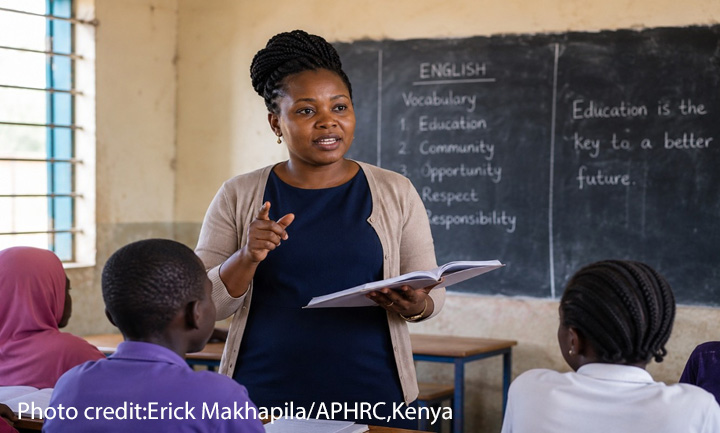
Meet a teacher in Kakuma Refugee Camp, Turkana County. Every morning she walks into a room built for far fewer and finds over 90 children waiting. She earns KES 9,000 a month — about USD 70. No formally-recognised teaching qualification. No union card. And, like more than 88% of refugee teachers in the region, no contract past this year, so she never really knows if she’ll still have the job in twelve months. She shows up anyway. Across Kakuma, Kalobeyei and Dadaab, her morning is not the exception – it is part of the job description. More than a quarter of refugee teachers here teach over 100 children a day, some with 150 children sharing a single textbook.
She is not an exception, and she is not anecdotal. Researchers went looking for teachers like her – 927 of them – for a 2025 study, Teacher Well-being in Refugee Camp and Host Communities in Kenya: A Case of Garissa and Turkana Counties, run by the African Population and Health Research Center (APHRC) under the TeachWell Voices and TeachWell Unlocking Playful Learning projects, funded by the LEGO Foundation. The study sat Kenyan and refugee teachers side by side. This piece is about one half of that picture: the refugee teachers holding camp schools together – and one policy tool that could actually change things for them, if anyone used it.
Here is the paradox revealed by the study. Ask these teachers if they are committed to their students, and 91% say yes – unmistakably. Ask if they have thought about quitting the profession altogether, and 51–59% also say yes. That is not a contradiction but a warning light, and it has been on for a while.
The study puts hard numbers on why. Among the 536 refugee teachers surveyed, between 73% and 82% hold no formally-recognised teaching credential. None of the refugee teachers are registered with the Teachers Service Commission (TSC), the body that controls formal pay and job security in Kenya, against more than 92% of national teachers. Women already make up fewer than one in ten refugee teachers to begin with. And because pay is tied directly to that registration, between 94% and 97% of refugee teachers earn at or below KES 9,000 a month – against KES 30,000 or more for their registered counterparts.
“A trained teacher is earning 9,000… today it can only buy a sack of sugar or rice.” – Male teacher, Dadaab
“They call us ‘incentives’… they don’t respect us.” – Male teacher, Kakuma
Some of that gap is about paper, not ability. To even qualify for Kenya’s 3-year Diploma in Teacher Education, you need a Grade C in the national secondary school leaving exam. Fair enough, until you remember what displacement does to a teenager’s schooling: overcrowded classrooms, closures, trauma and – for many girls – being pulled out to care for siblings or run a household. That Grade C bar isn’t really measuring talent. It is measuring how undisrupted your teenage years were. For most refugee teachers, that was never a fair fight.
And some of these teachers did not even need the diploma – they already had one. Before they fled Somalia, South Sudan, the Democratic Republic of Congo or Ethiopia, some completed full teacher-training programmes and spent years in front of a class. They arrived in Kenya as trained professionals. Kenya’s system looked at their credentials and had no mechanism to recognise any of it.
“I was stagnant… for 17 good years. Imagine from C1, 17 good years.” – Female teacher, Dadaab (C1 is the entry-level grade on Kenya’s teacher salary scale.)
The situation is: Kenya already built a fix for exactly this. Back in 2014, Kenya passed the Kenya National Qualifications Framework Act, the law that lets the country formally recognise skills people picked up outside a classroom. Cabinet used that law in January 2024 to approve something far more specific – the Recognition of Prior Learning Policy (RPL) – publicly launched two months later. The idea is almost embarrassingly simple: if you learned a skill on the job, through years of practice rather than a lecture hall, the government can test what you actually know and certify you for it. No repeating exams for knowledge you have already proven, on the job, for years. No pretending 17 years of teaching did not happen.
It is not hypothetical. Uganda already runs a version of this for teachers, through its Higher Education Qualifications Framework, and it works.
So why is this not working in Kenya? Because refugee teachers in Kakuma and Dadaab have never once been named a priority group under Kenya’s RPL Policy. Not one pilot has been commissioned for them. The tool exists. Nobody has picked it up and pointed it at the people who need it most.
We know, almost to the shilling, what picking it up would cost. Research linked to the TeachWell project estimates around 1,000 refugee teachers across Kakuma and Dadaab could go through an RPL-style process – trained assessors visiting schools, observing teaching, reviewing years of practice – with Teacher Training Colleges signing off on whether that record meets the bar for the diploma. Total cost: KES 17,000–26,000 (about USD 130–200) per teacher. For 1,000 teachers, that equates to roughly KES 17–26 million – a rounding error next to the education funding UNHCR, the World Bank and bilateral donors already commit to the region every year. This is what makes the ask uncomfortable: it is not expensive, and it is not untested. It is just unused.
There is political cover for this too. In March 2025, President Ruto launched the Shirika Plan for Refugees and Host Communities (2025–2036), which names teacher qualification and skills accreditation as a priority. In June 2026, Save the Children Kenya reported that the TeachWell Voices Project – pulling together the Ministry of Education, the TSC, County Education Boards and UNHCR Kenya – is actively discussing measures to recognise refugee teachers’ qualifications and register refugee schools. As one policy actor in Turkana put it, plainly: “The legislative gap does not exist. What is absent is implementation.”
This is not charity, and it should not be framed as such. When more than half of refugee teachers say they have thought about leaving, using the RPL Policy on them is not just fair, it is how Kenya keeps a teacher in the room instead of an empty chair.
So here is the ask. And it is a short one:
- The Kenya National Qualifications Authority should name refugee teachers a priority group under the RPL Policy and commission the Kakuma–Dadaab pilot.
- The Teachers Service Commission should build a dedicated registration category for teachers who go through it – Uganda already proved this can be done.
- UNHCR, the World Bank and bilateral donors should fund this, in line with commitments they have already made under the Shirika Plan.
None of that requires new legislation. It requires someone to use a policy that already exists.
The teacher in that Kakuma classroom will walk in again tomorrow, and the day after – for now. But her commitment is not infinite, and Kenya should not keep exploiting it for free. She is not asking for a miracle. She is asking Kenya to use a tool it already built. Now is the time to use it.
Note: The figures in this piece are drawn from a 2025 APHRC study, Teacher Well-being in Refugee Camp and Host Communities in Kenya: A Case of Garissa and Turkana Counties (TeachWell Voices & TeachWell Unlocking Playful Learning, 2025), funded by the LEGO Foundation and currently under peer review – treated here as field-based findings, not yet formally validated evidence. The study surveyed both refugee and host-community teachers; this piece focuses specifically on the refugee teachers in camp schools.