This blog was written by Alejandra Marín and Larissa Celis, VVOB – education for development.
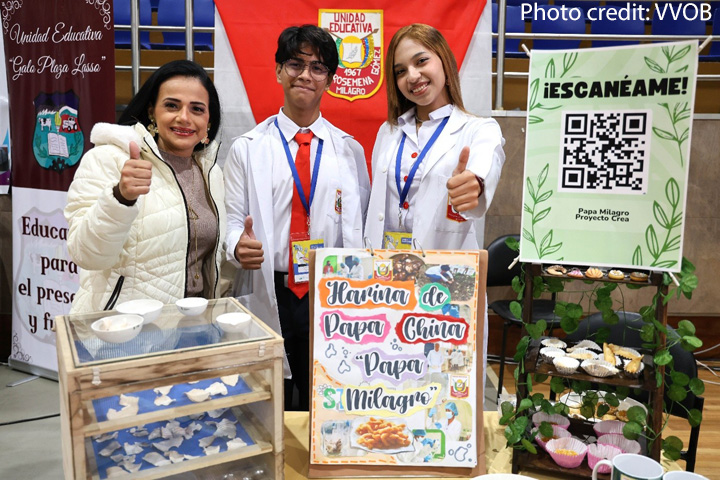
Throughout Ecuador, teachers are busy preparing for this year’s Feria Nacional CREA, a chance to highlight their project-based learning initiatives during a national education fair. To help teachers and students submit strong projects to the agriculture and climate change category, VVOB in Ecuador has developed a practical Teacher Guide. Originating from a contribution to the UKFIET conference in 2025, the guide shows how the right conversation, in the right room, can lead to tangible solutions.
VVOB in Ecuador is working with the Ministry of Education, Culture and Sports to organise the 2026 edition of the Feria Nacional CARE. Since its first edition in 2018, the national education fair promotes project-based learning and gives teachers the opportunity to showcase the results of this innovative teaching approach. By calling on learners to come up with solutions to real-world challenges, project-based learning develops a breadth of skills and teaches valuable lessons that prepare young people for entrepreneurship and employment.
The ‘agriculture and climate change’ category of the Feria Nacional CREA, challenges teachers and learners to present practical solutions to problems the agroindustry sector faces due to climate change. The sector transforms raw agricultural materials into value-added products through activities such as food processing, preservation and packaging. Take Unidad Educativa Eduardo Salazar Gómez secondary school, for example. Teachers and students from this school in Pifo, a rural village 28 km east of Ecuador’s capital Quito, are developing ‘Drip irrigation systems using hydrogels’, in response to decreasing water availability in the area. Historically known for its large irrigation streams and surface irrigation in agriculture, Pifo is seeing its water availability threatened by urbanisation and climate variability.
“This year, we are offering more extensive support to our teachers”, says Maribel Jarrín, Strategic Education Advisor at VVOB in Ecuador. “We noticed that they had difficulty connecting agriculture and climate change in project-based learning and needed more guidance to make student involvement and agency visible. During VVOB’s school visits to Tungurahua province, teachers also shared that they still had some practical questions about the Feria CREA. They weren’t sure about the participation guidelines and evaluation criteria, for example.”
A roundtable that sparked a solution
To improve submission quality, VVOB in Ecuador developed a Teacher Guide explaining how agriculture and climate change are deeply connected. Designed for direct classroom use, it offers ideas for project-based learning to work on with students and suggestions on how to link topics to the curriculum and to prior learning. The guide is designed as a step-by-step roadmap that helps teachers and students develop a project from the ground up. For classes unsure where to begin, it shows how to investigate a real local climate-related problem affecting an agricultural resource, link it to curriculum content, and formulate a clear guiding question. It also introduces Project-Based Learning, helping students move beyond a one-off classroom activity to develop a practical, climate-focused agricultural solution.
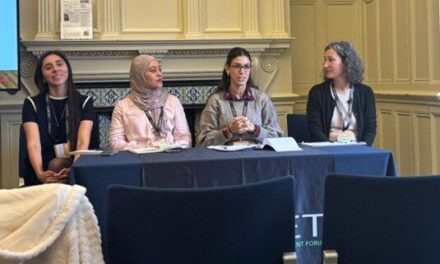
This idea took shape at the September 2025 UKFIET conference in Oxford. There, VVOB’s Ecuador and Uganda teams presented insights from their experiences in supporting agriculture and entrepreneurship teachers in secondary education and Technical and Vocational Education and Training (TVET). Both teams are implementing education initiatives under VVOB’s Skilling for Sustainable Futures Flagship to better prepare young people for employment or entrepreneurship in the agrifood sector.
“During this session, we held a roundtable where we collected feedback from the attendees on our project-based learning programmes”, explains Maud Seghers, Global Strategic Education Advisor at VVOB. “After sharing the difficulties teachers faced while submitting to our Feria CREA category, our peers advised us to develop a guide to support them.”
“One of the strengths of UKFIET, and its conference in particular, is that it sits precisely at the intersection between research, policy and practice from around the world. Some of the most valuable outcomes are indeed initiated at the conference, but progress well beyond”, say Emma Sarton, UKFIET Conference Chair, and Francesca Salvi, Deputy Chair. “For us, it is wonderful to have the opportunity to ‘close the loop’ and see how discussions during a UKFIET roundtable have contributed to the development of a practical resource that is now supporting teachers in Ecuador. This is exactly the kind of knowledge exchange the conference seeks to foster: collaborative, practice-oriented and focused on improving education in meaningful ways.”
English Call to action: Learn about our Skilling For Sustainable Futures flagship programme or discover other teacher materials on our website.
Spanish Call to action: Are you a teacher based in Ecuador interested in joining the Feria CREA, or just looking for ideas to integrate project-based learning in your teaching practice? Find the Teachers’ Guide on our website.