This blog was written by Ana Lagidze and Sara Hommel.
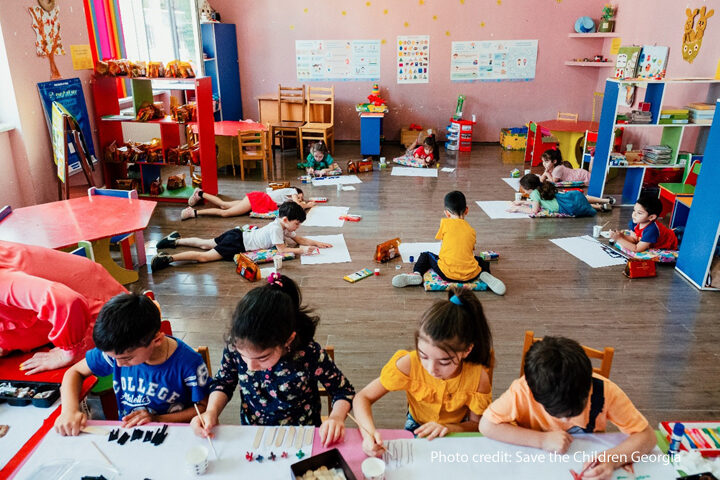
Between 2018 and 2025, Save the Children International in Georgia led a national education and child wellbeing scaling strategy with partners, including the Ministry of Education, National Preschool Association, Early Intervention Coalition, National Center for Teacher Professional Development, and nine municipal governments. This strategy aimed to train every teacher, and integrate every pre-school and primary school classroom, with the HEART programme. The key goals of the classroom-based social emotional support programme scale-up were:
- Professionalisation of the pre-school workforce
- Transforming classrooms into emotionally-supportive spaces (strengthening teacher capacity to support children’s social emotional development and wellbeing)
- Strengthening play-based approaches to education (in pre-school and early primary school)
- Improving school readiness (transition from pre-school to primary school)
- Improving inclusive education approaches (integration of children with disabilities into mainstream classrooms)
- Improving the social emotional wellbeing, development, and learning of children.
In early 2025, this work was progressing successfully with dedicated funding and ongoing partner commitments. HEART was expanding in pre-schools and primary schools across Georgia, with quality ethical standards that ensured appropriate training of teachers, supplies for classrooms, supportive monitoring, and evaluation. Programming results were extremely positive with continued demand for expansion. However, in the first quarter of 2025, Save the Children International announced that its office in Tbilisi, Georgia would close at the end of the year.
The local office had approximately 10 months to wrap up its work and shut down. Projects supporting Georgian pre-school and primary school education quality, the social emotional wellbeing of students, inclusive education and the integration of Ukrainian refugee children into the local school system, were suddenly at risk of collapse. Over the next 10 months, the small office of dedicated professionals in Tbilisi worked to develop strategies to sustain their successful education support portfolio, including the ongoing national scale up of HEART.
In the first half of 2025, HEART scale-up in pre-schools had reached 100% in the Tbilisi municipality and 50% countrywide. At the same time, work in primary schools was in its first phase with pilots running in 50 primary schools and 2 specialised schools (for children with disabilities). The announcement of the office closure was an unexpected shock. Strategy had to shift, from an ongoing process of expansion led by Save the Children (SC), to finding partners willing and able to replace SC’s leadership, while maintaining quality and ethical scaling standards.
SC’s leadership of the scaling process was complex. It included the coordination of the consortium of partners, co-financing scaling activities, quality assurance of training and programming standards, and collaborative leadership of monitoring and evaluation processes. Over the coming months, the SC Georgia team leading the scaling process consulted with local and national partners to identify a way forward. These consultations focused on maintaining ethical scaling standards, including quality (training, staffing, monitoring), fidelity (adherence to quality standards), and sustainability (partner commitments to sustaining quality and fidelity at scale).
Consultations with local partners reconfirmed commitments by municipal government stakeholders to provide funding needed to sustain the programme in locations where it had already launched (where teachers were already trained and supported to implement the programme in their classrooms). Local NGO partners confirmed their commitments to take over programme quality assurance by providing new training and supportive monitoring (coaching) to teachers in locations where scale had not yet been reached. Multiple partners expressed interest in co-funding key scaling activities, and conversations currently continue around new financing that will allow scaling to proceed.
To recognise the successful work of the partners to date, and to collectively confirm partner commitments going forward, SC Georgia organised a hand-over event in the last quarter of 2025. The event brought together scaling partners and celebrated the scaling success to date, confirmed stakeholder commitments to future scaling, and shared prospective partner capabilities for future support. It also introduced focal points responsible for different aspects of the scaling process going forward and confirmed partner responsibilities for key activities, including future teacher training and programme monitoring.
Throughout the process of scaling transition planning, several important lessons emerged on the ethical scaling of quality education support:
- Successful scaling often depends on the long-term partnership of multiple stakeholders within complex systems. When one partner is unable to meet their commitments, others must step in. Mapping current commitments alongside projected future capabilities of both existing and prospective partners, from the start of the scaling process and updating throughout, can help identify stakeholders to take over the responsibilities of those who drop out of the process along the way.
- Re-designing an existing scaling process based on changing partner roles and responsibilities requires significant commitment. Funding, programming support, coordination of partner roles and responsibilities, and the management of everyday challenges requires clear and consistent communication, coordination and collaboration. Regular documentation, review and dissemination on process feedback, alongside regular scheduled stakeholder consultations, can ensure that challenges are met with appropriate solutions in a timely manner.
- Ethical programming standards are always at risk of dilution during scaling, and even more so when scaling is interrupted by an unexpected shock such as the withdrawal of the leading partner organisation. Special attention to ethical programming standards is imperative to clarify and confirm during a scaling transition process (with clear partner responsibilities for oversight).
The future of the scaling process remains unclear (pending new funding commitments), while the sustainability of scale reached to date is confirmed. In the coming months, the remaining scaling partners will continue to support programme sustainability and plan next steps for continued scaling. With good communication, coordination and collaboration, the commitments of the remaining partners can see through the next phase of scaling to support the development, learning and wellbeing of children in Georgia. The withdrawal of the leading partner does not have to result in scaling failure, it can be an opportunity for new leaders to emerge to build on the years of collective success behind them and forge a path forward to complete the scaling they have worked long and hard to achieve.
For more information on the scaling of HEART in Georgia, please see:
Hommel, S., Kaimal, G. Arts-Based Approaches to Promote Mental Health and Well-Being: Supporting Children and Families in Conditions of Adversity. Routledge Press, 2024.