This blog was written By William C. Smith, Maia Chankseliani and Fatih Aktas.
Higher education is often overshadowed in global education debates. Yet many of the ambitions we have for education and development depend on it. Universities educate teachers, health professionals, engineers, civil servants and researchers. They produce and contest knowledge and create spaces in which different ideas and values can meet. What universities do, and what they are able to do, therefore matters well beyond their campuses.
There is a particular reason to ask about their future now. The global education agenda after 2030 is beginning to take shape at a moment when universities themselves face real pressures. Public funding is under strain, artificial intelligence is changing how knowledge is produced and taught, and rising nationalism and geopolitical competition are restricting international cooperation and reshaping student mobility. At the same time, higher education is increasingly expected to justify itself through employability, productivity and economic growth.
As we start thinking about what comes after 2030, we have an opportunity to ask what we want higher education to be for. That means thinking about universities’ responsibilities to their communities and to the wider world, as well as the forms of international cooperation that will be possible and necessary as the world becomes more fragmented.
How we answer these questions will have consequences. The way higher education is understood now will influence what governments fund and what institutions prioritise. Thinking about its future requires us to consider what should be preserved and where change is needed, while leaving room to imagine possibilities that do not yet exist.
To explore the current challenges and discuss possible futures of higher education, the Comparative Education and International Development (CEID) Research Group, with support from UKFIET, invited approximately 40 UK-based experts to the one day ‘Beyond 2030: The Future of Higher Education’ workshop in Edinburgh on 20 March 2026.
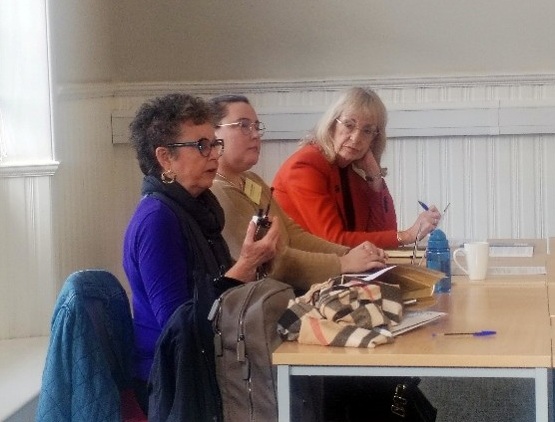 Professor Barbara Crossouard, Dr Jenna Mittelmeier and Professor Anne Anderson |
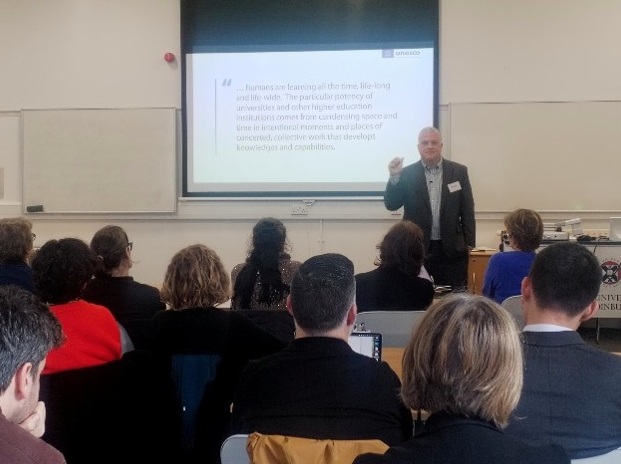 Noah Sobe presents UNESCO report |
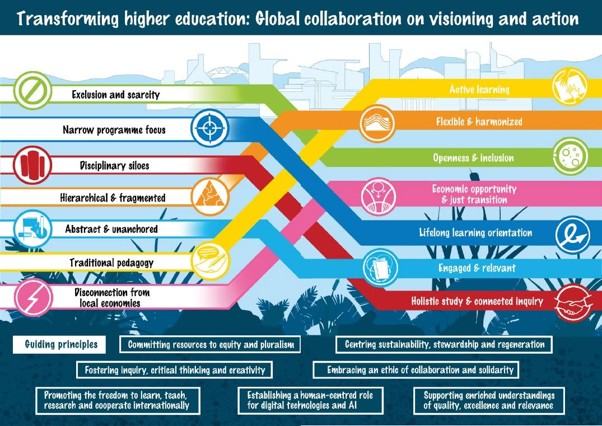
Kicking off the day was a presentation of UNESCO’s recent Transforming Higher Education: Global Collaboration on Visioning and Action report by UNESCO Chief of Higher Education Sector Noah Sobe. Based on consultations held during the third World Higher Education Conference in Barcelona in 2022, the report presents a roadmap for transforming higher education. It presents seven lines of transformation and calls for greater equity and pluralism, protection of academic freedom and international cooperation, critical thinking and creativity, a human-centred approach to AI, stronger collaboration and solidarity, greater sustainability and broader understandings of quality, excellence and relevance.
Inspired by the presentation, most of the day was dedicated to three moderated discussions. Facilitated by a senior and a junior researcher, workshop participants rotated through each, sharing their insights and expertise. The discussions explored desired futures around the purposes, pedagogy and knowledge of higher education, mobility and global cooperation, and universities’ contribution to a sustainable society.
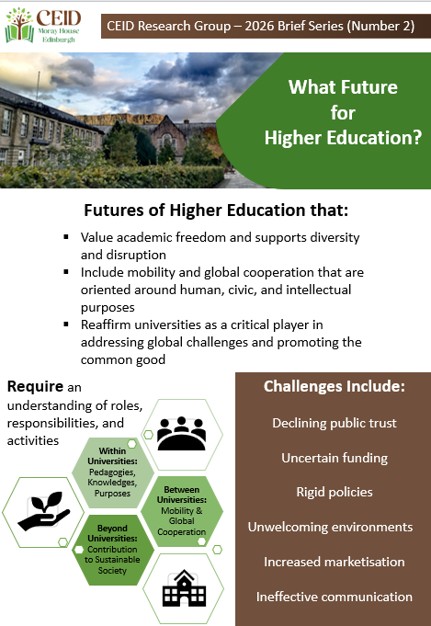
Following the workshop, multiple collective outputs were created to synthesise the discussions. Noah Sobe also drew from the workshop during his remarks at the Global Higher Education Symposium, on the sidelines of the UN High Level Political Forum (HLPF) in July 2026 in New York. He shared our brief, highlighting its key recommendations. All outputs from our Beyond 2030 workshop are available on the workshop’s home page.
 |
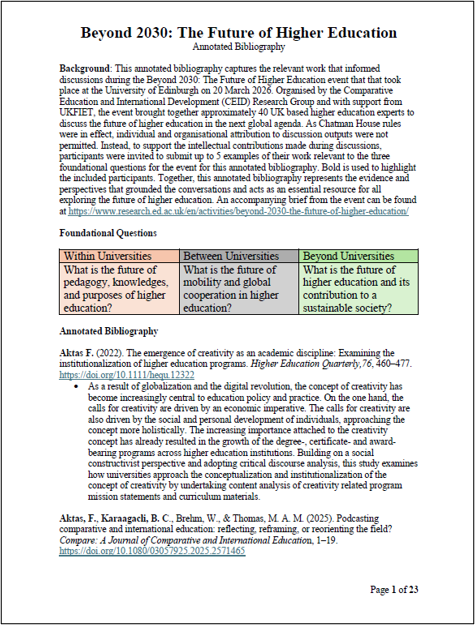 |
What future for higher education? Brief available on CEID website.
Emerging from the workshop was a call for greater confidence in the higher education sector. Participants argued that universities should move beyond reacting to immediate pressures, articulate more clearly what higher education is for, and take a more proactive role in shaping the future.
Participants cautioned against the current trajectory that narrowly values higher education for employment-related or economic concerns. Instead, they emphasised universities’ wider contributions to knowledge, critical inquiry, civil society and social development. Realising this broader vision requires stronger institutional environments that protect academic autonomy, reduce precarious employment and enable genuine inclusion. International mobility and cooperation should be oriented less around competition and revenue generation and more towards their human, civic and intellectual purposes, while international students should be recognised as students first rather than primarily through the lens of migration. Universities need stronger relationships with the societies in which they are embedded, and clearer ways to communicate their contribution to the public good.