This blog was written by Beth Gum, Senior Policy & Advocacy Adviser at the International Parliamentary Network for Education. Beth leads the area of foundational literacy and numeracy, working to grow political understanding and commitment to the issue to ensure all children learn to read, write and do basic mathematics by age 10.
Teaching children to learn to read, write and do basic mathematics are vital building blocks learnt in the early years. These basic skills are essential to continued learning, staying in school and thriving.
Yet globally, estimates indicate that 7 out of 10 children in low- and middle-income countries cannot read and understand a simple text by age 10. This has implications for a child’s potential, as well as a nation’s development, its human capital and social equality.
While diverse factors influence learning outcomes, one challenge that consistently emerges across contexts is the quality of teaching and ongoing teacher development.
Poor teaching quality is also compounded by teacher shortages and high attrition rates. Data from UNESCO shows that 44 million additional teachers are needed to achieve universal primary and secondary education by 2030.
The largest need is in sub-Saharan Africa, where there is a teacher shortage of 15 million. Even filling this gap won’t be enough, as teachers need professional development and support to be effective.
Pre-service teacher training is often limited and doesn’t incorporate effective, evidence-based strategies to teach children how to read. Opportunities for meaningful, ongoing Continuing Professional Development (CPD) are also frequently missing, fragmented or misaligned with teacher classroom realities. Further, career pathways are unclear, which can lead to low morale, lack of progression and ultimately teachers leaving the profession.
High teacher turnover during the years when students are learning foundational skills can weaken the support system on which early learning depends.
Hiring more teachers and equipping them, as well as existing teachers, with the skills and support to be effective is essential to improving learning outcomes.
The case of India: Addressing teaching quality through professional development
India is home to one of the world’s largest education systems and has grappled with many of these challenges. Since 2014, the Centre for Teacher Accreditation (CENTA) has demonstrated how opportunities for career growth, along with structured, teacher-led professional development, which is aligned with government systems, has helped address some of these barriers.
CENTA is a platform used by over 2 million teachers that certifies teachers on their competencies, provides personalised daily bite-sized learning, along with online and in-person training courses on different topics. CENTA works with government and private employers towards career paths for teachers. It works across the K-12 spectrum and on different topics, including foundational literacy, numeracy and early childhood education.
Through self-paced courses and partnerships with schools, CENTA awards teachers with globally- and nationally-recognised certifications, thereby creating motivation and a pull for teachers to grow their skills.
In India, CENTA partners with state and district governments to support teacher certification and development, and to improve the quality of education. By working closely together, teacher training courses can be aligned with local needs to help fill gaps in government resources. Through a link to career growth, there is direct motivation for teachers to engage.
This collaboration ensures that professional development is not an isolated intervention but is embedded within the education system and aligned with government priorities and teacher aspirations.
CPD for teachers as a daily habit
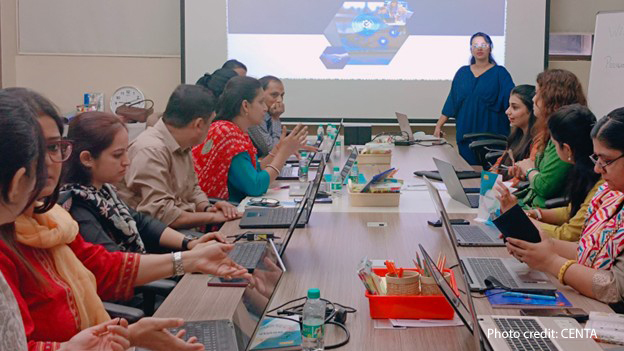
A key barrier to providing CPD is the resources and time required to roll out high-quality, regular training opportunities for teachers. Rather than relying on infrequent or poor-quality workshops, teachers can use CENTA’s platform to engage in short, focused learning sessions that last typically 5 to 10 minutes a day.
This design helps build a daily learning habit, making professional growth manageable alongside demanding teaching schedules and removing the need for travel or time off work to attend CPD trainings.
Through the gamified learning modules, teachers can gain clear insights into their strengths and areas for improvement, while governments can see which schools and teachers are being certified. This helps to target investments more efficiently and focus training resources where they are most needed.
From India to the continent of Africa
CENTA’s teacher training approach is gaining acceptance from teachers in Africa too, with over 75,000 teachers already learning on CENTA’s platform. This includes over 25,000 teachers each from Ghana and Nigeria, which translates to over 7% of Ghana’s teacher population and nearly 3% of Nigeria’s. Other countries such as Kenya, Uganda and Ethiopia are also growing in usage.
This presents a maturing and timely opportunity for governments in these countries to consider institutionalising teacher-led transformation in their respective education systems, much like in the case of India.
Implications for foundational learning
In low- and middle-income countries, learning outcomes remain low. Improving the quality of teacher instruction has been proven to be a key pathway to increasing learning outcomes.
Whilst online certification is out of reach for teachers without access to a device and electricity, there are broader lessons that can be taken for education worldwide. For example, the use of career growth as a powerful motivator, the short snapshots of time for CPD, and the use of local learning circles.
Improving foundational learning outcomes requires sustained investment in teachers. Not only during pre-service, but throughout their careers. Early reading and numeracy are cumulative. If a child does not master decoding or number sense early, all later learning becomes harder. That makes teacher expertise in foundational learning and their classroom instruction unusually high-stakes and worth ongoing support.
When CPD is continuous, evidence-based and connected to recognition and system-level decision-making, it has the potential to strengthen teacher capacities, confidence and retention.
As countries seek solutions to ensure every child is learning to read, write and do basic mathematics, models that combine teaching quality and retention alongside government leadership offer a promising path forward – one that places teachers at the centre of learning.