This blog was written by Sumana Dhanani, College of Medicine and Health Sciences, University of Rwanda.
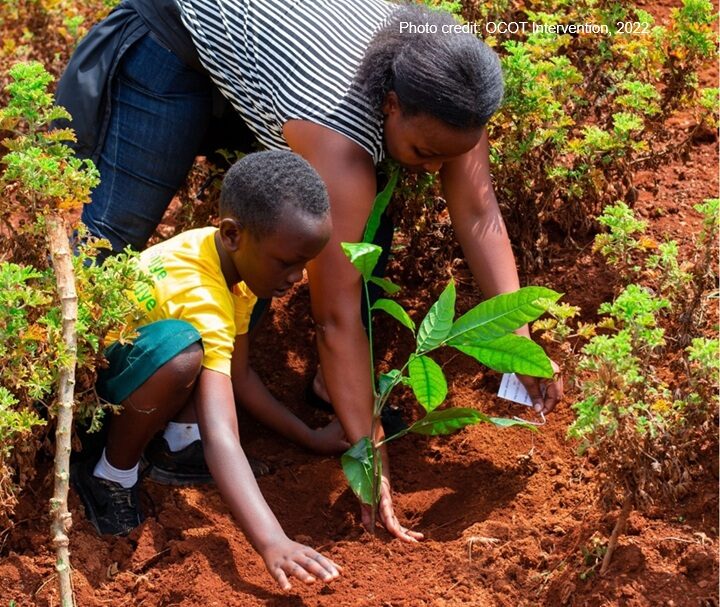
When a child plants a tree, something transformative occurs, not merely in the physical landscape, but within the child themself. Through planting and caring for a tree, children participate in a meaningful ecological activity that fosters pride in their contribution to environmental health, deepens their connection to the natural world, and cultivates a sense of agency in addressing climate change. This blog aims to share lessons on what it takes to implement school-based environmental education at scale, from the perspectives of teachers, head-teachers and parents.
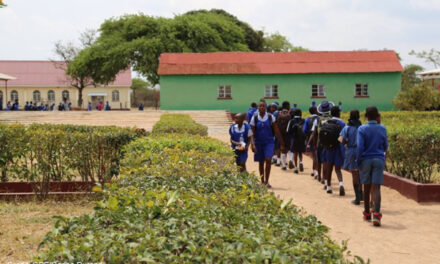
The One Child One Tree (OCOT) initiative is an example of a school-based environmental education programme by the University of Rwanda’s College of Medicine and Health Sciences (UR-CMHS), that implements a three-part intervention in Rwandan primary schools: (1) an education package on the biology and culture of trees; (2) a community tree-planting ceremony, in which each child plants their own tree; and (3) ongoing child forest maintenance activities. The model emphasises learning with nature as opposed to learning about it, positioning trees as dynamic learning tools. The first phase of OCOT was implemented in two Rwandan primary schools, reaching more than 500 children. Unpublished preliminary evidence from this phase demonstrated statistically significant improvements in children’s emotional state, nature connectedness, and intrinsic aspirations – key indicators of child mental wellbeing and environmental agency.
Nevertheless, the issues of sustainability and scalability remain key questions. Implementing school-based interventions that are introduced by external organisations can be complex, and present considerable challenges. Such programmes require coordination across multiple stakeholders – teachers, administrators, parents and community members – each with competing priorities and resource constraints. Schools often struggle with insufficient time allocated for new programmes, limited teacher capacity to deliver intervention components, and varying levels of teacher motivation and engagement. For OCOT and other programmes like it to achieve their ambition of becoming scalable at the national level, a fundamental shift is required from externally-led implementation to a model in which beneficiaries themselves lead implementation.
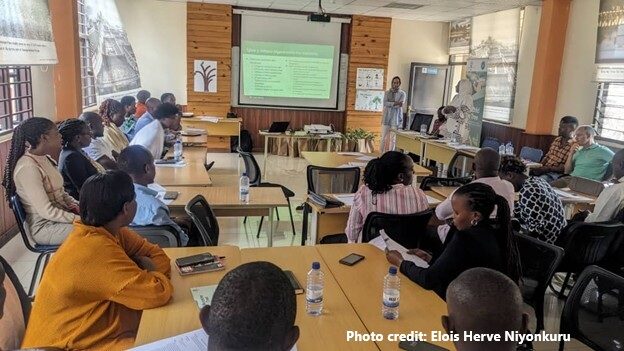
To address questions about scalability and sustainability, the UR-CMHS’s OCOT team conducted a participatory workshop in collaboration with colleagues from the University of Cambridge and the Rwanda-based NGO Green Stars, who also implements environmental programmes at schools. The Teachers’ Co-Creation Workshop brought together school stakeholders who participated in the implementation of either OCOT or Green Stars’ school-based environmental interventions to reflect on their experiences together. The workshop was attended by 38 participants – teachers, head teachers and parents from OCOT or Green Stars schools – who had deep understanding of school operations, and the practical possibilities for embedding environmental initiatives within existing institutional structures. Facilitators from the workshop collected group perspectives and discussions that captured the essence for how stakeholders considered the scalability of these interventions. Three major themes emerged from these conversations, providing insights on what is needed for OCOT and similar school-based interventions to be implemented at scale.
1) Ownership, capacity building and recognition
For school-based environmental projects to be sustainable and scalable, they must be owned and championed by the school stakeholders themselves. Teachers and school leaders need to feel motivated, proud and skilled to deliver such projects, viewing them as central to their school’s mission and identity.
Workshop participants emphasised that promoting ownership for the intervention among school stakeholders is important. Teachers stressed that “assigning responsibility for the land to the teachers and students will make them take ownership”, and that “current schools are the champions in sharing the lessons with others.” In this powerful model for scaling environmental programmes, schools with established experience could support neighbouring schools through peer-to-peer learning and advocacy. However, teachers expressed concerns about the additional workload implications, which reflects a critical reality: for teachers to embrace programme delivery alongside their existing teaching responsibilities, it needs to be viewed as valuable for them. In the case of OCOT, for example, the intervention’s value for teachers can be highlighted in several ways: the programme can support their teaching, enhance their environmental knowledge and professional growth, inspire their students, and give recognition for their efforts. For such interventions to be implemented in schools with minimal external support, teachers need to be empowered as champions through targeted support, training and recognition programmes that build ownership and sustain engagement.
2) Technical support
Internal motivation and ownership among school stakeholders form the foundation for sustainable implementation of environmental initiatives. Yet schools also require concrete external support in the form of expertise and resources. Participants expressed that schools “need to work with the government and experts who know technically how to plant trees, which tree, where, and what soil.” Working with government agronomists prevents schools from making costly mistakes about species selection. Connecting schools with the relevant governmental expertise is a key service that external partners might provide to enable sustainable implementation.
Schools also require material support to implement such interventions; participants identified that “there is a need for support in getting the seeds and saplings, soil and the way to protect them.” Without access to such resources, the commitment to tree-planting is difficult for schools to fulfil, regardless of how motivated staff may be. External partners can facilitate access to these resources, either by providing them directly or by connecting schools to reliable supply chains and funding mechanisms.
3) The importance of timing
A third significant theme concerned timing – one of the most immediate practical barriers to implementation. Participants identified timing challenges at multiple levels: alignment with formal school timetables, coordination with seasonal growing conditions, and sufficient lead time for preparation.
In order for a tree-planting intervention like OCOT to work as a school-led programme, schools must identify and protect dedicated time for it within their schedules. Participants emphasised the need to “establish the time for OCOT in the weekly plan,” recognising that programmatic quality means little without dedicated classroom time. More broadly, schools would have to synchronise tree-planting ceremonies within the existing school calendar, rather than impose external timelines that disrupt normal school operations. The agricultural calendar presents a second timing constraint: in Rwanda, there is little flexibility in when trees can be planted. The country’s bimodal rainfall pattern means tree survival depends on aligning tree-planting with seasonal soil moisture availability. A participant articulated the challenge this presents: “If we are going to plant in October/November, eight weeks is not enough, as schools start in September – then we have to complete by the end of October.” This reveals that the implementation of environmental interventions at schools requires careful planning to target optimal planting windows, with enough lead time built in for training teachers, delivering lessons to students, procuring materials and conducting the tree-planting ceremonies.
The vision of OCOT, and for many other environmental programmes, is ambitious: to reach every single primary school in the country. For OCOT, the aim is that each Rwandan child plants their own tree, and ultimately to establish OCOT as an international movement. Achieving this vision is not possible if implementation is led by external partners; rather it requires a model where schools themselves become the main drivers of the intervention, and are supported by the structures in which they operate, including support from specialised tree-planting organisations. The voices of teachers, school leaders and parents who participated in the Co-Creation Workshop reveal that successful scaling depends on creating enabling conditions across the three dimensions mentioned above.
The OCOT team is committed to hearing the voices of school stakeholders, and translating their recommendations into a strategic implementation plan. This approach offers lessons for how civil society organisations can support schools in becoming self-sustaining leaders of environmental or social programmes. Any organisation working to embed an external intervention within schools and scale it sustainably would have to consider how their innovations can be adopted, adapted and integrated so that they become sustainable.
Acknowledgements
Funding for this event was provided by The Mastercard Foundation and University of Cambridge Climate Resilience and Sustainability Research Fund, 2025. A note of thanks to Professor Stefan Jansen and Elois Herve from the University of Rwanda, Hawa Shaban and Emmanuel Kwizera from Green Stars, Professor Ricardo Sabates and Dr Pui Ki Patricia Kwok from the University of Cambridge, as well as the head teachers, teachers and parents from Karama Primary School, School for Excellence IMANZI, SOS Kigali, Groupe Scholaire KABINGO TSS and Ecole primaire Bukinga for their participation in the workshop and contribution to this post.