This blog was written by Rajalaxmi Singh, PhD Candidate, Centre for Development Studies (CDS), Thiruvananthapuram, India. For the 2025 UKFIET conference, a record 37 individuals from 15 countries, including Rajalaxmi, were provided with bursaries to assist them to participate and present at the conference. The researchers were asked to write a short piece about their research or experience of attending the conference.
A surreal arrival in Oxford
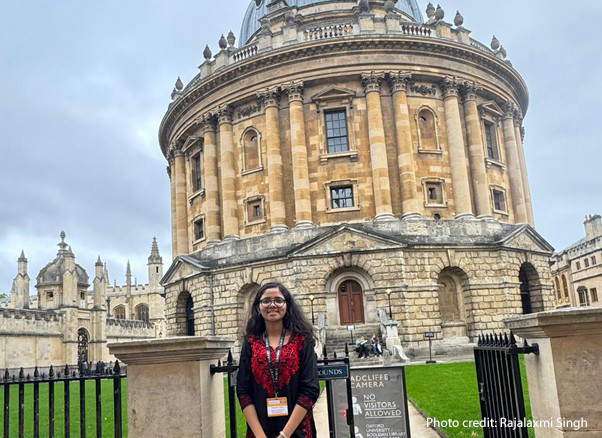
Attending the UKFIET 2025 Conference in Oxford in September marked a defining moment in my PhD journey. I arrived in Oxford with a mix of excitement and quiet curiosity. Stepping off the bus and walking towards the New College accommodation felt surreal. As I walked through the historic streets, defined by stunning architecture and a deeply-embedded academic aura, I could hardly believe that I was actually there—and that I would be presenting my work the very next day. For someone from a socio-economically constrained background, such spaces can feel intimidating, shaped by long histories of privilege and access. Being present, presenting my work, and learning alongside scholars from across the world, was therefore more than just an opportunity; it was a remarkable moment in my academic journey.
Engaging with global conversations on education
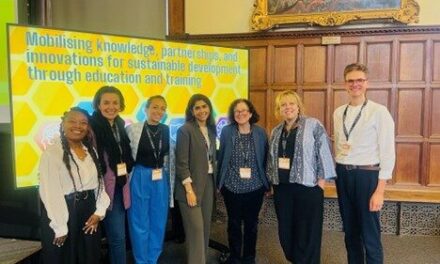
The conference brought together over 700 participants from 66 countries. The central theme of the UKFIET 2025 Conference was “Mobilising Knowledge, Partnerships, and Innovation for Sustainable Development through Education and Training”. Discussions throughout the conference highlighted how evidence, collaboration and innovation can collectively strengthen education systems in more sustainable and equitable ways. Researchers, practitioners and policymakers gathered to engage with the pressing challenges of the global learning crisis and learning inequalities—a theme that lies at the very heart of my own research on foundational learning among children in India. The scale and diversity of the conference were impressive, but what stood out most was the shared commitment to dialogue and reflection.
The keynote address on the state of education in Gaza grounded the conference in a sobering reality. Professor Ahmad Kamal Junina detailed the depth of the crisis: the systematic destruction of schools and universities, the loss of thousands of young lives, and the dismantling of the very infrastructure required for children to learn. Hearing that nearly 97% of schools in Gaza have been destroyed was deeply distressing, and a stark reminder of the fragility of the “right to education”. Professor Yusuf Sayed further reminded us that violence against education is not only physical but also erodes dignity, hope and fundamental human rights. This was undoubtedly one of the most powerful keynote sessions I have ever attended.
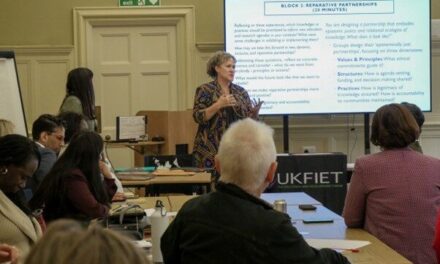
Alongside the keynotes, the conference unfolded across symposiums, paper presentations, plenary discussions and creative sessions, each offering distinct spaces for engagement and reflection. The early career researchers’ meetings and interactions with journal editors were equally valuable. One of the most enriching aspects of the conference was the opportunity to engage with scholars whose work I have long read and cited. As a PhD student, interacting directly with policymakers and practitioners blurred the boundaries between theory and practice.
The conference’s creative and participatory sessions further encouraged open dialogue, making the space inclusive and intellectually stimulating. A session on “Invisible Backpacks: Understanding and Addressing Intersectional Barriers to Learning in The Foundational Years”, organised by the Language and Learning Foundation stood out in particular. It created space for collective reflection on persistent learning challenges in India. Discussions highlighted how multiple barriers shaped by caste, poverty and first-generation schooling intersect to shape children’s learning experiences. Participants also reflected on systemic issues of power and governance, and how these shape whose voices are heard and whose needs are prioritised. The session underscored the need for targeted support, greater attention to linguistic and cultural diversity, and stronger recognition of children’s varied learning needs.
What made the UKFIET Conference distinctive
What made the UKFIET conference particularly distinctive—unlike many conventional academic conferences—was its emphasis on dialogue, reflexivity and collective problem-solving. Perhaps the most enduring takeaway from the conference was the collective call to rethink how we respond to the global learning crisis, especially as the 2030 education goals approach. The conference challenged participants not only to generate rigorous evidence but also to reflect on whose knowledge counts, who remains unheard, and how diverse perspectives can contribute to more inclusive and equitable education systems. In the end, the UKFIET 2025 Conference was not only a place for academic discussion—it was a space to engage with ideas critically, confront uncomfortable realities and imagine learning environments that can better serve every child, regardless of background or circumstance.
I am deeply grateful to UKFIET for the bursary support, which enabled my participation and made this incredible learning experience possible.