This blog was written by Professor Irfan Ahmed Rind, Dean of the Faculty of Language Studies at Sohar University, Oman. He is also an honorary Professor of Education at Sukkur IBA University, Pakistan. His work focuses on governance, accountability and the impact of global reforms on local education systems. He led the ADLG and UCLG-ASPAC project as consultant.
Delivering United Nations Sustainable Development Goal 4 (SDG 4) – inclusive, equitable, quality education for all – will not be achieved from capital cities alone. Around the world, evidence increasingly shows that progress depends on what happens in districts, municipalities and communities.
Global data backs this up. The OECD estimates that local and regional governments are responsible for more than half of public investment across its member countries. Meanwhile, the UN Sustainable Development Solutions Network highlights that the majority of SDG targets require strong engagement from sub-national actors. The Joint SDG Fund similarly stresses that roughly 65% of the goals connect directly to local mandates.
Put simply: without localisation, the SDGs stall.
What does this mean for Pakistan?
Pakistan has embedded the SDGs within national planning, yet delivery ultimately depends on provinces and districts. In Sindh, stakeholders in the largely rural districts of Larkana and Naushahro Feroze consistently rank education as their most urgent development priority.
The challenge is stark. According to data from the Pakistan Bureau of Statistics, literacy in these districts sits just above 50%, with a persistent gender gap: male literacy around two-thirds, female literacy only a little over 40%.
Local actors often argue that decisions taken far away struggle to reflect ground realities. But what would meaningful decentralisation actually require?
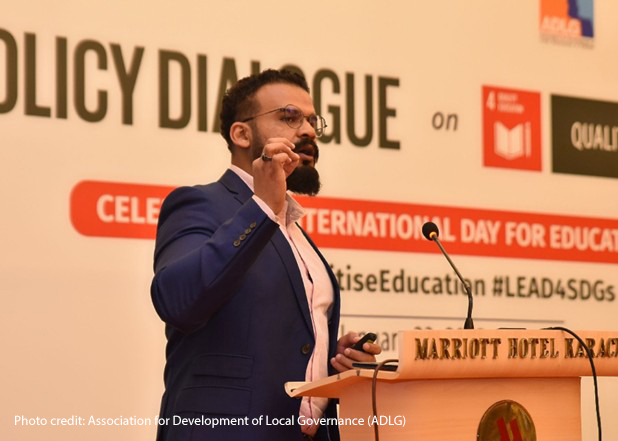
To explore this, the Association for Development of Local Governance (ADLG) and United Cities & Local Governments Asia Pacific (UCLG-ASPAC), with support from the European Union, carried out participatory research with district leaders, education officials, civil society, and private providers.
Learning first: awareness changes everything
One striking finding came before governance reform was even discussed.
When participants were asked about their knowledge of the SDGs and SDG 4, baseline awareness was low. After structured dialogue and learning sessions, understanding increased dramatically. Pre-session scores averaged 1.8 out of 5; afterwards they jumped to 4.5.
This matters. When local leaders grasp how global commitments link to everyday decisions, they begin to see themselves as actors in delivery – not just implementers of instructions.
Hope meets reality
Stakeholders were largely enthusiastic. They believed local control could help tailor education to language, culture, labour markets and gender barriers. Yet optimism quickly collided with practical constraints.
Authority without power
District offices often lack control over budgets or staffing. Responsibilities may be devolved, but permission to act remains centralised. Without clarity, decentralisation risks becoming, in one participant’s words, “policy on paper.”
Capacity gaps
Many offices operate with limited data systems, weak connectivity and shortages of trained personnel. Planning, procurement, monitoring and legal compliance are complex tasks; they require sustained professional development, not one-off workshops.
Funding bottlenecks
Participants repeatedly compared unfunded decentralisation to “building a castle on sand”. Without fiscal authority, districts cannot repair schools, hire teachers or provide materials.
Weak accountability chains
Good decentralisation depends on transparent information and community oversight. Yet mechanisms for monitoring performance, sharing data and learning from mistakes remain underdeveloped.
Partnerships – promise and risk
NGOs and private providers can extend reach and innovation, especially for marginalised learners. But if poorly regulated, partnerships may widen inequality rather than reduce it.
What should happen next?
The conversations generated clear priorities.
- Give districts real decision space – over hiring, spending and adapting programmes – matched with defined responsibilities.
- Build policy through participation. Parents, teachers, students and community organisations understand barriers that statistics alone cannot reveal.
- Treat capacity building as long-term system strengthening. Financial management, data literacy and collaborative leadership are foundational.
- Follow the money. Without predictable, decentralised financing, autonomy is symbolic.
- Invest in monitoring systems that are useful locally, not just upward-reporting tools.
- Shape partnerships around equity, transparency and public value.
International experience shows it can work
Evidence from countries such as Brazil, South Africa and India demonstrates that when local authority is matched with resources and accountability, enrolment rises, disparities narrow and services become more responsive. Decentralisation alone is not magic – but decentralisation with investment can be transformative.
A window that is closing
With 2030 approaching fast, incremental change is no longer enough.
This research shows that once local stakeholders understand the SDG framework, they are ready to lead. What they lack are the tools, resources and trust.
If Sindh can empower districts like Larkana and Naushahro Feroze, it could offer a model for the rest of Pakistan – and a reminder to the global community that sustainable development is ultimately built from the ground up.