This blog was written by Koen Verrecht, Enabel, the Belgian agency for international cooperation.
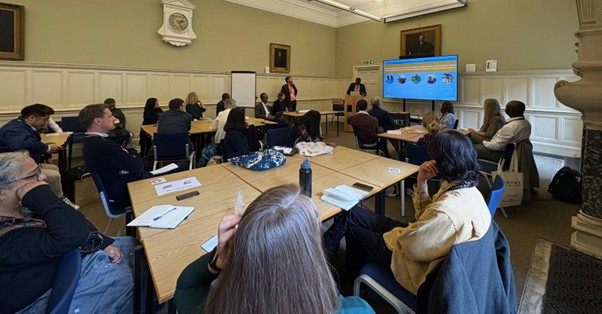
In September 2025, the UKFIET conference in Oxford brought together global education leaders, innovators and practitioners to mobilise knowledge, partnerships and innovations for sustainable development. As part of the Regional Teachers Initiative for Africa (RTIA) Facility, the Enabel Innovation Hub had the privilege of hosting a creative workshop focused on one of the most urgent challenges in education today: How do we scale teacher-focused innovations across diverse contexts, without compromising quality?
Rather than showcasing finished solutions, the session created space for honest reflection on what it really takes to move promising teacher innovations from pilot to system-level change.
Real-world cases, real-world questions
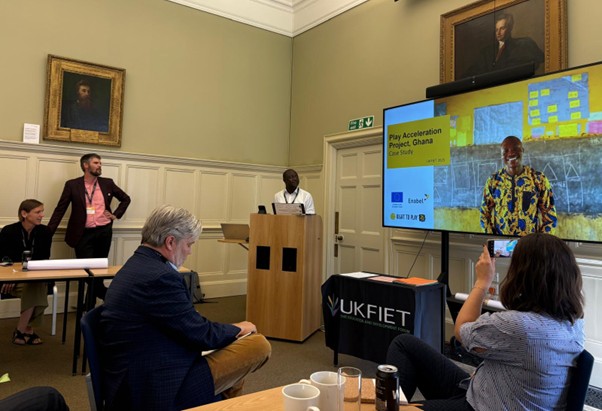
Our session was built around three case vignettes from RTIA grantees in Ghana (Right To Play), Zambia (World Vision) and Malawi (DAPP). Each group tackled a different scaling challenge, using simple templates to identify solutions, assumptions and missing links for embedding innovations in broader systems.
Right To Play Ghana: Motivation and participation
The breakout group exploring Right To Play’s blended teacher training in Ghana raised critical questions:
- Are teachers engaged throughout their learning journey, and do they have a say in shaping the course?
- What external motivators (like CPD points or recognition) actually drive participation?
- How can we ensure teachers’ intrinsic motivation is addressed, not just extrinsic incentives?
The discussion highlighted the need for more direct engagement with teachers to identify barriers, the value of communities of practice and the importance of practical, hands-on demonstrations. The group also suggested exploring self-nomination for participation and leveraging social media to share play-based learning in action. As one participant noted, “Play-based learning is not just about student outcomes. How can it support teachers in their professional journey?”
DAPP Malawi: Parental engagement in the TRIO model
The DAPP group focused on the TRIO approach, where groups of three students collaborate at their own pace, supported by teachers and, crucially, parents. The discussion surfaced practical strategies for engaging parents:
- Invite parents to schools to see the TRIO model in action.
- Use “model parents” to inspire others, showing how children can balance household chores and academic work.
- Strengthen school management structures to better involve parents, and challenge the prevailing notion that education is solely the teacher’s responsibility.
The group agreed: for innovations like TRIO to scale, parental buy-in is essential. Changing mindsets and building trust takes time, but it’s a win-win for families and schools alike.
World Vision Zambia: Digital access and peer learning
Notes from the World Vision Zambia table captured the complexity of scaling digital teacher training in rural contexts:
- Access to devices (e.g., Raspberry Pi per school) and offline solutions are vital.
- Peer learning and teacher champions can help drive adoption, but incentives and motivation must be investigated.
- Engaging students in technology use, giving teachers more time to adapt, and understanding what skills are truly a priority for teachers are all key.
- The group also questioned whether digital skills acquisition would actually lead to improved teaching practice, a good reminder that technology is a means, not an end.
At the close of our session, one participant raised a thought-provoking question: Why didn’t we address government engagement as one of the critical challenges? This is without doubt, a, if not the, fundamental hurdle in scaling education innovations. We fully acknowledge that without meaningful government buy-in, even the most promising initiatives can struggle to achieve sustainable impact at scale. However, the focus of our workshop was shaped by the case vignettes brought forward by our grantees, who selected the challenges most relevant to their current scaling journeys. The fact that government engagement was not highlighted as a primary challenge in these cases may actually reflect the strong relationships and collaborative groundwork these organisations have already established with government partners. It is a reminder that while some barriers may be overcome, others remain. And that scaling is always context-dependent and evolving.
Co-creating principles for scaling
Throughout the workshop, participants mapped out potential solutions, surfaced assumptions and identified missing links. Some cross-cutting principles emerged:
- Engage stakeholders early and often, especially government, teachers and parents.
- Foster communities of practice for peer-to-peer learning and support.
- Design for flexibility and context: one size does not fit all.
- Leverage both intrinsic and extrinsic motivators for sustained engagement.
- Allow time for adaptation and mindset change: scaling is a marathon, not a sprint.
 Looking ahead
As we walked from our hotel to the conference each morning, we passed the Siew-Sngiem Clock Tower in Oxford, inscribed with the words:
“It’s later than you think… but never too late.”
This message resonated well with our workshop’s spirit. The challenges in education are urgent, but with creativity, collaboration and a willingness to learn from each other, it is never too late to make a difference.
We hope these reflections resonate with others working at the intersection of innovation, teacher development and systems change, and invite continued exchange across contexts and approaches.
Thank you to all participants, facilitators and partners who made this session a success. Let’s keep the conversation and the momentum going.