This blog was written by Kate Matzopoulos, University of Bath. For the 2025 UKFIET conference, a record 37 individuals from 15 countries, including Kate, were provided with bursaries to assist them to participate and present at the conference. The researchers were asked to write a short piece about their research or experience of attending the conference.
Walking through the sessions at the UKFIET education conferences, it’s hard not to notice a pattern. Regardless of the focus of the presentation, many of them begin and are framed by the same reference point — the United Nations’ Sustainable Development Goals (SDGs). Over time, this repetition begins to feel thoughtless: merely following the motions of how international education is done. How is it that, across such diverse contexts and experiences, so much of international education is still framed under a single understanding of what ‘a good education’ or ‘sustainable development’ should look like?
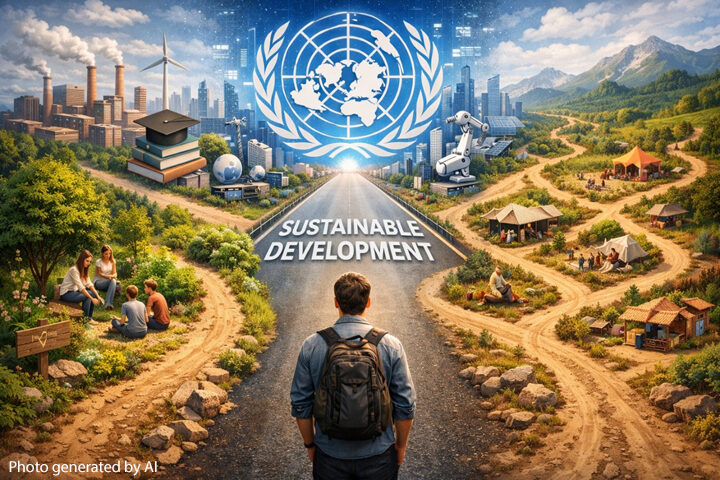
The seemingly wide acceptance of the SDGs in international education spaces has become almost unquestioned – not by presenters or those attending these sessions. They are used to provide legitimacy, a way to frame ‘development’ as universal, and create a shared language for progress. Yet, this uncritical application of global frameworks, a copy-and-paste logic, risks flattening difference. How is it possible that in international settings, where we are supposedly hearing from diverse places and perspectives, so much of our work continues to revolve around a single worldview of development? What does it mean for the plurality of educational thought when sustainability and development are continually mashed together in the oxymoron: ‘sustainable development’?
In Learning as Development: Rethinking International Education (2017), Daniel A. Wagner offers a reframing of the relationship between learning and development. His focus on learning, rather than economic growth, being the foundation of human development, is an important shift from older, growth-centric models. Wagner sees the UN’s SDGs, and particularly SDG 4 on education, as a positive evolution. One that focuses on global commitment to equity, inclusion and lifelong learning. He acknowledges that earlier development paradigms were shaped by colonial histories and economic agendas, and calls for more evidence-based, human-centred approaches.
While such intentions are admirable, it remains within a reformist framing because it still rests upon a universalist logic — one that assumes a single route for progress, dangerous in that it is framed as ‘global’. In attempting to make development more humane, the framework still assumes that the kind of development proposed by SDGs itself is the desired and inevitable path. This is where I would like to pause. What if the very idea of ‘learning as development’ sustains, rather than unsettles, the development paradigm? What if the SDGs, despite their rhetoric of inclusion, serve as tools that keep the language of progress, modernisation and intervention intact — simply wrapped in terms that appropriate emancipatory language?
Scholars such as Winkler et al. (2021) have described this tendency as the work of ‘missionaries of development’ — those who speak the language of sustainability while remaining committed to development logics that depend on inequality and extraction. Continuing to work uncritically within such frameworks allows colonial hierarchies to persist. We see, once again, so-called ‘developed’ nations setting and controlling the agenda of what counts as ‘sustainable’ or ‘quality’ education, while diverse epistemologies and knowledge systems remain sidelined. To truly accept epistemic diversity would require acknowledging that the universalist view of knowledge — inherited from colonialism — was and remains deeply flawed in its insistence on a singular narrative.
This uncritical transfer of frameworks also reproduces familiar patterns of misrepresentation. Global development narratives often select certain ‘issues’ within the Global South — gender inequality, poverty, climate vulnerability — without recognising that communities already possess their own counter-narratives, philosophies and practices that address these concerns differently. Yet such local expressions rarely find space within the global discourse. And the local expressions that do find their place in global spaces, often come firmly attached to global development narratives, where despite the allure of a ‘local flavour’ added to a universalist perspective, these communities remain positioned as deficit, as developing, as needing help, or in progress toward an ideal defined elsewhere.
As Crossley (2008) reminds us, even when development programmes are intended to empower, the recipients of aid often do not get to decide how and where that aid is directed. The goals and metrics are determined by those offering assistance, not by those living the realities on the ground. This dynamic, repeated across education projects framed by the SDGs, reinforces rather than redistributes power.
To decolonise international education, then, is not simply to localise or ‘contextualise’ the SDGs. It is to question the very logics that inform them — it might be better to ask, whose futures are being (re)imagined and whose knowledge counts as evidence? Working in a more sustainable way, requires decolonising our approach to international education; being willing to step outside the comfort of global metrics and measurable indicators, and to listen to other ways of knowing and being that have long existed in the world, but are often not granted the legitimacy in policy spaces that they deserve.
This means seeing learning not as a tool for development, but as a relational process grounded in community, land and reciprocity. It means recognising that sustainability cannot be achieved by sustaining development — especially when development itself remains tied to extractive, colonial epistemologies. True sustainability begins with coexistence, not conversion.
As we continue to gather in international education spaces, perhaps we might pause before citing yet another SDG. We might ask instead: what possibilities for learning, for being and for thriving already exist beyond the reach of these universal frameworks? And what might happen if, rather than aligning our work under a single banner, we began to speak across worlds — not in translation, but in relation?