This blog was written by Maha Shauyb and Cathrine Brun, Centre for Lebanese Studies. It was originally published on the GPE KIX website on 15 December 2025.
Education system resilience has become a new agenda promoted especially by development agencies and now required of governments in the Global South. However, mainly framed through the gaze of humanitarian agencies, resilience risks being reduced to a short-term, crisis-management tool, one that, at best, absorbs shocks in order to stabilise systems rather than transform them.
In this blog, we draw on our research across the Arab world, exploring these tensions through our ongoing study of education system resilience in Lebanon, Jordan, Yemen, Tunisia and Egypt and our recently published desk review of resilience in education systems and accompanying brief. This work is part of the Observatory on Education System Resilience initiative by the Global Partnership for Education Knowledge and Innovation Exchange (GPE KIX), a joint endeavour with the International Development Research Centre (IDRC).
Our main finding is that the emergency-oriented model of education system resilience, often advocated by development agencies and other stakeholders, tends to overlook the deep-rooted, historically grounded forms of collective resilience that communities have cultivated over generations. Instead of building on concepts like sumud, a political, justice-oriented tradition of steadfastness, the current resilience framework and policies ask schools and societies merely to adapt, absorb and endure.
The consequences are profound. Resilience becomes an add-on designed to meet donor anxieties rather than local aspirations. It narrows political agency, shrinks the horizon of reform, and risks reproducing the logic of earlier colonial projects: imposing external frameworks that suppress local ways of imagining and building the future. If education is to be reclaimed as a transformative and aspirational public good, resilience must be re-rooted in the histories, struggles and ambitions of the societies it claims to serve, rather than being reduced to a requirement by international aid agencies to ‘lighten the burden’ of aid.
Resilience: A contested meaning
To understand why this matters, we must examine how resilience is being defined and by whom. Our analysis of education strategies developed by education ministries in Lebanon, Yemen, Jordan, Egypt and Tunisia in the past 15 years revealed that national policy discourses often reproduce global development framings of resilience, even though these narratives diverge substantially from locally embedded interpretations.
Globally, and more specifically for development agencies, resilience is defined as the capacity of individuals, communities or systems to anticipate, absorb and recover from crises. In education, it is framed as an internal coping ability that enables learners and systems to manage disruptions with limited external support.
Such framing positions resilience as self-reliance and adaptability, often depoliticizing crises by treating them as natural or inevitable rather than products of structural inequality, violence, or global power relations. Crucially, this normalises perpetual emergency and reduces pressure for systemic reform.
Consider the case of Jordan. The Jordanian Crisis and Risk Management Strategy for the Ministry of Education 2023–2027 explicitly notes that it was designed to “keep pace and align with global trends in dealing with crises and disasters through a strategic planning approach” (p. 7). Guided by the Global Alliance for Disaster Risk Reduction and Resilience in the Education Sector (GADRRRES), an international platform that promotes children’s rights, resilience and sustainability in education, the strategy was shaped by global frameworks and principles. As a result, the national plan reflects international conceptions of resilience rather than those emerging from local contextual understandings. This approach to resilience stands in contrast to the MENA region’s own vocabulary for endurance and resistance concepts such as sumud, which reflects collective resistance, solidarity, and a justice-oriented struggle for liberation. While global discourse emphasises adaptation (murūna in Arabic), sumud emphasises transformation. Conflating the two depoliticises regional realities that are plagued by occupation, colonialism and authoritarianism and diminishes more aspirational understandings of what education should enable.
Why sumud matters: Surviving versus prevailing?
Sumud, meaning steadfastness, has long animated the political imagination across the Arab world. The distinction is not only semantic. Sumud is not concerned merely with survival; it is about resistance, dignity, liberation and building a just future. In contrast, resilience, as often translated to and understood as murūna ‘flexibility’, asks only whether a system can continue to function under pressure. It does not ask whether that functioning aligns with community aspirations or meaningful educational outcomes.
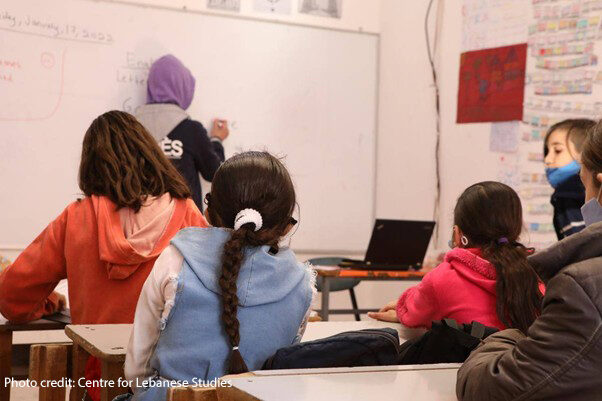
Lebanon provides a revealing example. Measured through the narrow indicators favoured by resilience frameworks, the Lebanese education system has survived the compounding crises that have hit the country over the past seven years. Overall, schools stayed open throughout economic collapse, political paralysis and mass displacement. Enrolment numbers amongst nationals remained largely steady. But when we look beyond the headline indicators, a very different picture emerges. Teachers’ salaries have collapsed; access for the poorest Lebanese children and refugees has deteriorated; governance mechanisms remain fragile; and years of learning have been lost. Inequality worsened. A system may be labelled “resilient” for enduring crises, but the lived reality is one of profound injustice and declining education quality.
Whose resilience?
The growing emphasis on resilience in global policy raises a fundamental question: resilience for whom, and according to whose terms? Within the education sector, resilience is primarily framed through the lens of Education in Emergencies, aligning with donor and state priorities to keep systems operational during prolonged crisis conditions. Within this logic, resilience becomes a technical capacity: the ability to absorb shocks rather than pursue change.
In our analyses of national education plans, we found that they increasingly mirror donor project templates: they are more like proposals drafted for financing and reporting than collective visions rooted in community aspirations. This “projectisation,” as one education expert described it—where education strategies are reduced to project plans for disbursing development funds—strips education reform of its political character and reframes education systems as technical infrastructures to be optimised under pressure. In essence, planning becomes less about societal futures and more about managing donor concerns.
Reclaiming education as a transformative endeavour
To move beyond these limitations, education systems in the region must reclaim their transformative foundations. This requires shifting from resilience as murūna (adaptation and flexibility) to resilience grounded in sumud (steadfastness and justice). Sumud allows communities to articulate the futures they want, identify the structural changes needed to achieve them, and position education as a vehicle for dignity, liberation and collective imagination.
Put simply, education must aspire to more than murūna; it must cultivate the political imagination and collective power necessary to build futures worthy of the people it serves.
A more grounded approach to resilience requires three shifts:
First, expanding engagement beyond government ministries to include educators, communities, civil society and local thinkers could help build a more comprehensive and grounded understanding of resilience.
Second, the language of resilience itself requires flexibility. If the term resilience does not resonate locally, it should not be imposed. Concepts such as sumud, which carry political, social, and historical meaning in the region, may offer a more authentic starting point.
Third, the scope of resilience must extend beyond emergency preparedness to encompass sustainable and equitable development through long-term structural reform. It should support planning that advances the long-term aspirations of communities, grounded in justice, equity and dignity, not just their ability to withstand crises.
The global education community often assumes that its model of resilience is self-evidently beneficial. This assumption must be revisited in dialogue with the very communities whose futures it shapes. Without this shared reflection and redefinition, resilience risks becoming yet another layer of externally driven agenda rather than a genuinely transformative project that aligns with existing processes.