
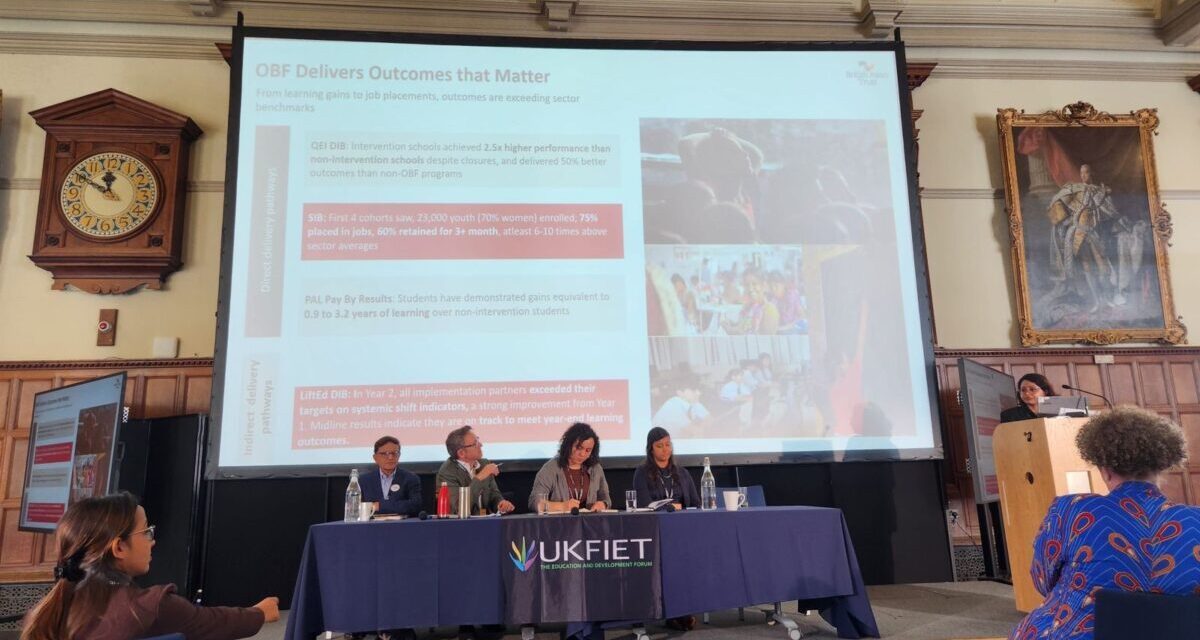
This blog was written by Shraddha Iyer, British Asian Trust. For the 2025 UKFIET conference, a record 37 individuals from 15 countries, including Shraddha, were provided with bursaries to assist them to participate and present at the conference. The researchers were asked to write a short piece about their research or experience of attending the conference.
Why collaboration matters more than ever
The Opening Plenary of UKFIET 2025, where Professor Ahmed Kamal Junina joined us virtually from Gaza, was a powerful reminder of the vulnerability and fragility of education systems. In Gaza alone, more than 650,000 students have been deprived of education for a third consecutive year.
This crisis is not a recent one. Reflecting on 2020, nearly 168 million children globally were out of school for almost a full year due to COVID induced school closures. Even five years later, around 130 million children in the countries hardest hit by the pandemic continue to experience school disruptions, now driven by the worsening climate crisis. As recently as 2024, an estimated 234 million school-aged children and adolescents across 60 countries have been affected by crises and remain in urgent need of access to quality education.
This plenary session reaffirmed several key beliefs for me. First, in an era marked by growing uncertainty, ongoing conflict and shrinking global aid, it is crucial to use existing resources more efficiently to ensure maximum impact and value for money. Second, the scale of today’s education challenges is far too large for any single organisation to address alone. What we need now are bold, innovative and collaborative partnerships. Lastly, collaboration should no longer be seen as optional. While not a panacea for all global development challenges, collaboration can prove to be valuable in addressing complex large socio-economic problems.
Reflections from our experience convening large outcome-based collaboratives in India
The urgency to ensure that every child learns despite conflict, climate shocks or resource constraints demands that we move beyond traditional ways of working. In this context, the UKFIET 2025 Conference and its theme, ‘Why mobilising knowledge, partnerships and innovation matters now more than ever’, could not have been more timely.
It prompted me to reflect on the British Asian Trust’s eight-year journey in building large-scale, multi-stakeholder, outcome-based financing (OBF) partnerships worth $40+ million with 40+ partners, benefitting 4+ million people across education and livelihoods.
OBF is a funding approach where payments are made only on the achievement of pre-defined, independently verified outcomes, as opposed to on inputs or activities. While partnerships and collaborations may not offer a one-size-fits-all solution to development challenges, I have observed several advantages of this approach in the context of OBF, particularly in settings where collective action is essential for achieving meaningful outcomes. I specifically draw most of these insights from the LiftEd initiative, our flagship $20 million effort to strengthen Foundational Literacy and Numeracy in India, which I have had the privilege of leading.
- Laser sharp focus on outcomes and shared accountability: OBF collaboratives ensure that every partner has a skin in the game, moving the dynamic from transactional funding to collective problem-solving. By aligning incentives around shared outcomes, stakeholders engage deeply in design, deliberation and risk-sharing. For example, as India’s first foundational learning impact bond aimed at strengthening systems, LiftEd grappled with multiple unknowns at the outset: limited data on the right outcomes to measure, few benchmarks on targets and understandable scepticism. Yet that unified focus on outcomes brought funders, evaluators and implementers together to co-create a programme that was both aspirational and grounded in local realities. The Quality Education India impact bond was the British Asian Trust’s first OBF initiative in education to improve literacy and numeracy outcomes for Grades 1-8. It witnessed an innovative collaboration between an EdTech organisation and a grassroots non-profit partner to drive better engagement and adoption on the EdTech platform during COVID-19 induced school closures, ensuring that learning outcomes do not suffer during a crisis or uncertainty. While collaboration between social organisations is not a unique phenomenon, jointly owning accountability for end outcomes, monitoring data in real time together and creating localised strategies in a structured way was facilitated because of OBF structures.
- Flexibility, adaptability and innovation for implementers: Certain OBF instruments, such as impact bonds, offer implementers greater operational flexibility because a risk investor typically provides the upfront working capital and takes on the financial risk, giving implementers more room to deploy resources in the ways they deem most effective for achieving the agreed outcome. Focusing on outcomes rather than specific interim activities drives implementing partners to use resources strategically, adaptively and take data-backed decisions, rather than getting caught up with rigid budget lines. Such autonomy enables implementors to experiment with innovative practices and retain only effective ones that can lead to the end outcomes. For example, one LiftEd implementation partner shifted from professional peer learning circles as an intervention pathway, which faced low engagement, to strengthening principals’ and teachers’ capacity in assessment-informed pedagogy and mentoring, as it demonstrated stronger potential to deliver the desired end outcomes. A useful example from a more volatile setting is the Jordan Refugee Impact Bond, which highlighted the value of flexibility and adaptive management in a context where needs and conditions can shift rapidly. Jordan transitioned from an acute refugee crisis in 2014–16 to a relatively more stable period by 2021. The flexible structure of the impact bond enabled the programme to adjust its delivery model in response to these changing circumstances, adaptations that would have been challenging under a traditional, rigid grant arrangement.
- Risk and reward sharing: Collaborative approaches, whether OBF or otherwise, distribute both risks and rewards, encouraging stakeholders to take bolder, innovative steps. For instance, the EdTech Accelerator which is part of the broader LiftEd initiative, pooled patient capital from multiple philanthropic funders to support eight early-stage EdTech solutions for foundational learning and numeracy grades in underserved communities. This collective approach reduced the financial burden on any single funder and allowed experimentation with innovative EdTech models.
- Collaborative governance: While multi-stakeholder collaborations are often celebrated, bringing diverse actors together and sustaining momentum over time is rarely simple and OBF provides a blueprint to build an accountable collaborative. Having strong governance structures with clearly defined roles and responsibilities, regular working group meetings, open forums for discussing both successes and challenges, and taking decisions backed by data rather than intuition, all foster a culture of learning and create an environment where partners feel heard and aligned around common goals. Over the past three years, I have been fortunate to be part of the British Asian Trust as a neutral convener, learning how to bring teams together, often with diverse perspectives, to make joint decisions, build consensus, navigate conflicts, anticipate risks and ensure choices remain both practical and aligned with our shared mission.
Reflecting on these lessons, it becomes clear why the UKFIET 2025 conference focus on mobilising knowledge, partnerships and innovation resonates so strongly. Meaningful change often emerges when diverse actors work together with trust, shared accountability and purpose.