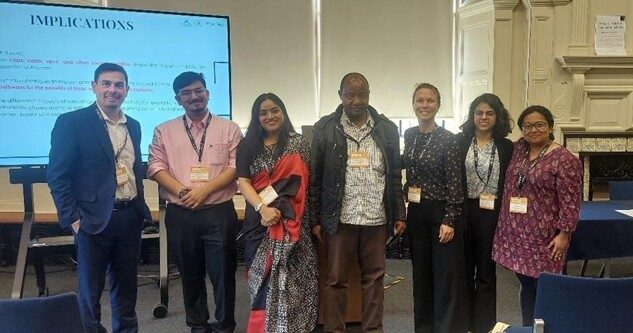
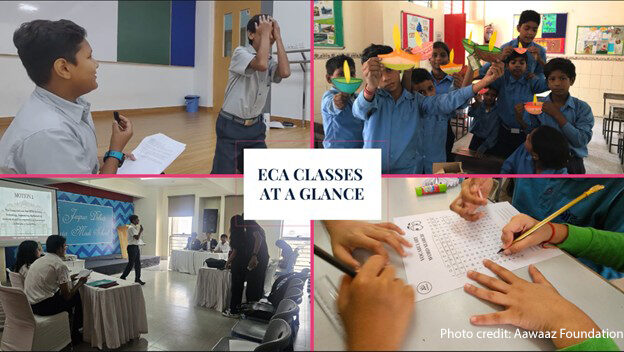
This blog has been written by Yajur Dolwani, Aawaaz Foundation. For the 2025 UKFIET conference, a record 37 individuals from 15 countries, including Yajur, were provided with bursaries to assist them to participate and present at the conference. The researchers were asked to write a short piece about their research or experience of attending the conference.
Extracurricular activities (ECAs) have long been seen as add-ons to schooling. But what if these activities are actually the key to forging deeper peer connections, boosting student participation, and creating classrooms where every voice is heard and valued?
Social capital in classrooms and its impacts have become vital subjects in the study of classroom environments around the world, and especially in countries like India, where the social, economic, cultural and learning diversities present in classrooms need increased cognisance. Set against this context, educators and institutions work to identify and implement new learning environments that mobilise the social capital in classrooms by incorporating pedagogical tools and strategies and finding ways to improve existing setups. ECAs have often been associated with their ability to have a positive impact on students’ lives by facilitating new friendships, inspiring pro-social sentiments, and fostering a sense of belonging. Their impact on student peer environments is notable, and we at Aawaaz Foundation began with a curiosity to understand these impacts in a methodical, quantitative manner to observe and highlight the way forward.
In wanting to do so, we examined a diverse set of ECAs like debate, sports, writing, theatre, robotics, dance and arts. As a part of a large-scale study named Socionomy, we aimed to understand the relationship between students’ choice of these ECAs and their social outcomes. We sought to answer two major questions:
- Are different ECAs associated differently with students’ peer connections and classroom experience?
- Is this association of different ECAs with student classroom perception and experience mediated by gender?
We conducted a large-scale social network analysis in 23 schools across 13 cities in 4 Indian states, giving us a sample size of 13,718 students, spanning social demographics including gender, religion, location (rural/urban), income levels and region.
Students were asked to nominate their “very good friends” and “good friends”, and answered questions to explore their comfort in classrooms, social embeddedness and overall participation. One of the questions asked as part of this was the students’ choice of favourite ECA, making the answer to their choice of ECA the independent variable in this analysis.
Four dependent variables were identified to understand student social capital:
- Very good friend nominations
- Comfort in asking doubts in class
- Perception of bullying in the class
- Frequency of student participation.
A weighted multiple linear regression model was run for each outcome, including main effects for each activity, as well as interaction effects between gender and each activity. Weights were assigned to all regression models to account for the average of the activities they participated in, and controls were placed to account for potential confounding effects, varying due to school, grade levels and gender.
For each dependent variable, the effects were as follows:
- Very good friend nominations: Sports and debate/Model United Nations (MUN) became associated with higher overall friendship nominations. When gender is accounted for, male students with writing or dance as their favourite ECA have fewer nominations than females, and male students with sports have higher nominations than females (who also have strong positive effects).
- Comfort in asking doubts in class: Students who picked debate/MUN were the most comfortable in asking doubts in class, closely followed by robotics, arts and sports, whereas gendered analyses did not yield any significant effects.
- Perception of bullying in the class: Students opting for theatre and debate/MUN perceive bullying easily around them, and from a gendered lens, male students in debate, dance and photography have a higher perception of bullying.
- Frequency of student participation: Students opting for Debate/MUN, theatre, sports, robotics, dance and arts show more positive associations towards class participation, whereas gendered analyses did not yield any significant effects.
These results gave us a lot to think about as an organisation that works with ECAs, as well as one that is thoroughly invested in conducting research in the educational space in India, as the implications of these results highlighted potential steps forward for both these directions.
On a research front, this social network analysis can be understood as a foundational, preliminary study in order to understand base-level associations between the selected variables. This means we now need to explore on a deeper, qualitative level the social norms, gendered or otherwise, that surround these activities. This analysis highlights the need for pedagogical frameworks to incorporate ECAs into mainstream academic frameworks. One of the ways to do so would be by supplementing traditional classroom learning with extracurricular-style activities. In doing so, we would provide educators with the tools to mobilise the peer networks of their diverse classrooms. Our takeaway for the future would be to change the perception around extracurricular activities, as not just a space for fostering hobbies and friendships, but rather to see them as a force to create increasingly communicative and cognisant classrooms.