This blog was written by Sakina Jafri, doctoral student at the Faculty of Education, University of Cambridge. Sakina’s work is driven by a commitment to social justice, inclusive education, the amplification of global majority voices and the advancement of teacher education. The blog was originally published on the BAICE website on 27 February 2026.
Positionality has never felt like an abstract concept to me. It is lived, felt, and carried into every space I enter. As a brown Pakistani American woman, a former primary school teacher, a mother, and now a doctoral researcher at the University of Cambridge, my identities are multiple, intersecting, and constantly evolving. They do not grant me authority to speak for others, but they shape how I listen, how I relate, and how I engage. Writing as an early career researcher (ECR), this reflection traces how my positionality shaped my research with South Asian heritage teachers and how it further unsettled and sharpened my experience at the UKFIET conference. It explores the tensions between language and action, belonging and critique, and asks what accountability and reflexivity demand of us as emerging scholars.
When I first moved from the US to the UK, I was struck by the persistence of what Hirsch (2018) called “The Question”: Where are you from? These four words often left me feeling like something was wrong with my presence. Whether the individuals asking me were being friendly, curious, or perhaps thought that I didn’t belong had nothing to do with the way the question left me feeling. Over time, I have learned how to answer this question with a lot more ease, while recognising that belonging is policed within spaces, including academic and educational ones, especially against the backdrop of institutional whiteness (Ahmed, 2007). My own journey from Lahore, New York City, Palo Alto to London has taught me that this unease and vulnerability, often seen as a barrier, is a bridge that connects me to others.
This awareness has been central to my research. As Campbell-Stephens (2021) reminds us, leading and researching for equity and inclusion requires deep self-awareness. For me, this has meant sustained reflection on my ethnicity, my privileges, my biases, and the way these intersect in different educational and academic spaces. As hooks (1994), drawing on Jane Ellen Wilson, reflects, finding one’s voice is not about fitting into pre-existing niches but about collectively making spaces where voices can stand clear of background noise. While my background inevitably shapes my work, I continue to work reflexively to ensure that my personal experiences do not determine or limit the way I think.
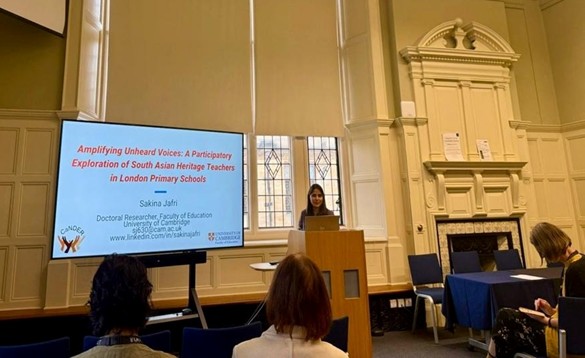
South Asian heritage teachers in London primary schools are the storytellers in my research. It deliberately moves away from deficit framings and instead centres teachers as agentic professionals who navigate ethnicity, motherhood, religion, ambition, and institutional whiteness with creativity and care. Through sustained engagements with teachers, schools, and institutional processes, the study traces my own transition from being new to the UK education system to developing a grounded understanding of its structures, cultures, and everyday realities.
Through this process, I came to recognise both the specificity of racialised and minoritised experiences and the universality of many challenges teachers face, such as workload intensification, emotional labour, accountability pressures, and the tension between personal values and institutional demands. While ethnicity, heritage, and whiteness profoundly shaped how these were experienced, the research revealed shared vulnerabilities and collective struggles that cut across differences. This recognition deepened my empathy for the profession globally. During research and as I write I try to attend carefully to language and remain alert to how knowledge is produced. Critical consciousness, as Howse et al. (2019) argue, is never finished; it requires constant work.
It was with this positionality and set of commitments that I attended the UKFIET conference in September 2025. It was my first time attending UKFIET. I arrived expecting familiar rhythms: panels, presentations, conversations about education, practice, and policy. I anticipated intellectual stimulation and opportunities for networking, and I did experience these.
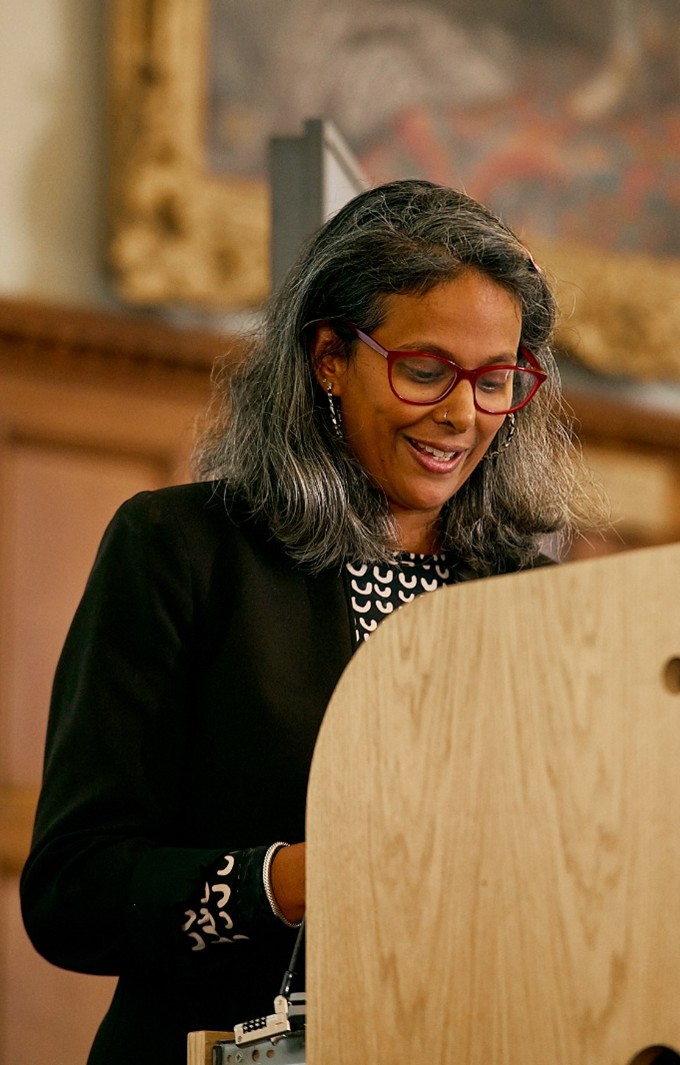 From the opening keynote of Assistant Professor Kamal Junina at Al-Aqsa University, which foregrounded the importance of online resources, mentorship, and sustained solidarity for students in Gaza, to the BAICE plenary on anti-racism and reparative futures, where Professor Arathi Sriprakash challenged us to confront intergenerational injustice and move beyond abstraction, the conference created space for urgent, necessary, and some awkward conversations. The closing plenary by Judith Herbertson left us with a hopeful yet realistic sense of possibility, acknowledging both the constraints and the transformative potential of education.
What I did not anticipate, however, was how different the conference would feel- emotionally, relationally, and politically. (To be clear I am no expert at attending conferences and before UKFIET had only attended a handful of conferences and workshops at this scale). While questions of equity, inclusion, and representation were foregrounded. I found myself unexpectedly out of place. As a teacher, as a woman, and as a researcher who pays attention to language, I experienced a tension between the words we were using and our actions, particularly against the backdrop of the Examination Halls of Oxford.
This is not a tension unfamiliar to me. Studying at a university with a complex history of maintaining white hegemony, I am acutely aware of the irony of critiquing institutional whiteness while occupying spaces made accessible to me through institutional affiliation. As Schwoerer et al. (2018) note, participation in elite spaces can mean participating in what we critique.
During the conference I found myself distancing myself, not from the remarkable work being highlighted by individuals and organisations represented there, but from some of the language used to frame global educational challenges. Positioning the Global South primarily as the site of need and the Global North as the saviour sat uneasily with me, particularly as a researcher working with South Asian heritage teachers in London. The problems that teachers were facing in Nepal, Nigeria and Peru were not that different from what teachers in London encounter. The range and extent might have been varied based on the context, but these were all issues that teachers had raised, issues I have experienced.
Language matters. How we frame problems matters. Inclusion and equity are important guiding principles for me, and I remain attentive to how even well-intentioned discourse can reproduce othering.
I am certain that I, too, will look back at my own writing and presentations and recognise the language I would choose differently. This work is never finished, and I remain open to learning and critique.
My presentation at UKFIET was received generously, yet as I left the conference, I found myself briefly convincing myself that perhaps this space was not meant for someone like me, that it was for a different kind of researcher, and I was comfortable accepting that in September.
It was only in December, in conversation with several of the teachers that participated in my study, that this thinking was disrupted. As we discussed findings, policy, and the current educational climate, they reminded me why these spaces matter. Their message was clear: research matters most when it translates into action. Visibility matters but so does accountability. And I, too, am accountable. What good is my research if it does not feed back into the worlds it emerges from? What good is my attention to language and framing if I’m not applying it?
As I reflect on UKFIET and my evolving identity as an early career researcher, I am left with sharper questions and not a clear conclusion.
How can we, as ECRs, inhabit academic spaces in ways that remain accountable to the communities we research with, while still allowing ourselves to grow, belong, and be seen? How do we ensure that our attention to language translates into action, and that our presence in elite spaces does not distance us from the worlds our work emerges from?
Perhaps the answer lies not in certainty, but in sustained reflexivity and in continuing to ask who we are in relation to others, whose voices are centred, how they are centred, and what kinds of rooms we are helping to build. As Táíwò (2022) reminds us, “we build the kind of rooms in which we can sit together, rather than merely seeking to navigate more gracefully the rooms history has built for us” (p. 84).
For me, UKFIET was not simply another conference. It was a moment of becoming and a reminder that research, especially as an ECR, is never neutral. It is personal, political, political, and collective, and it asks not only what we know, but who we are becoming in the process.